How to Find Planets in the Night Sky
Finding a planet in the night sky is often easier than you might imagine. Five planets — Mercury, Venus, Mars, Jupiter and Saturn — can be seen with the unaided eye, and some are among the brightest objects in the sky. Uranus and Neptune are much fainter, but they can also be found with binoculars or a telescope and a little preparation.
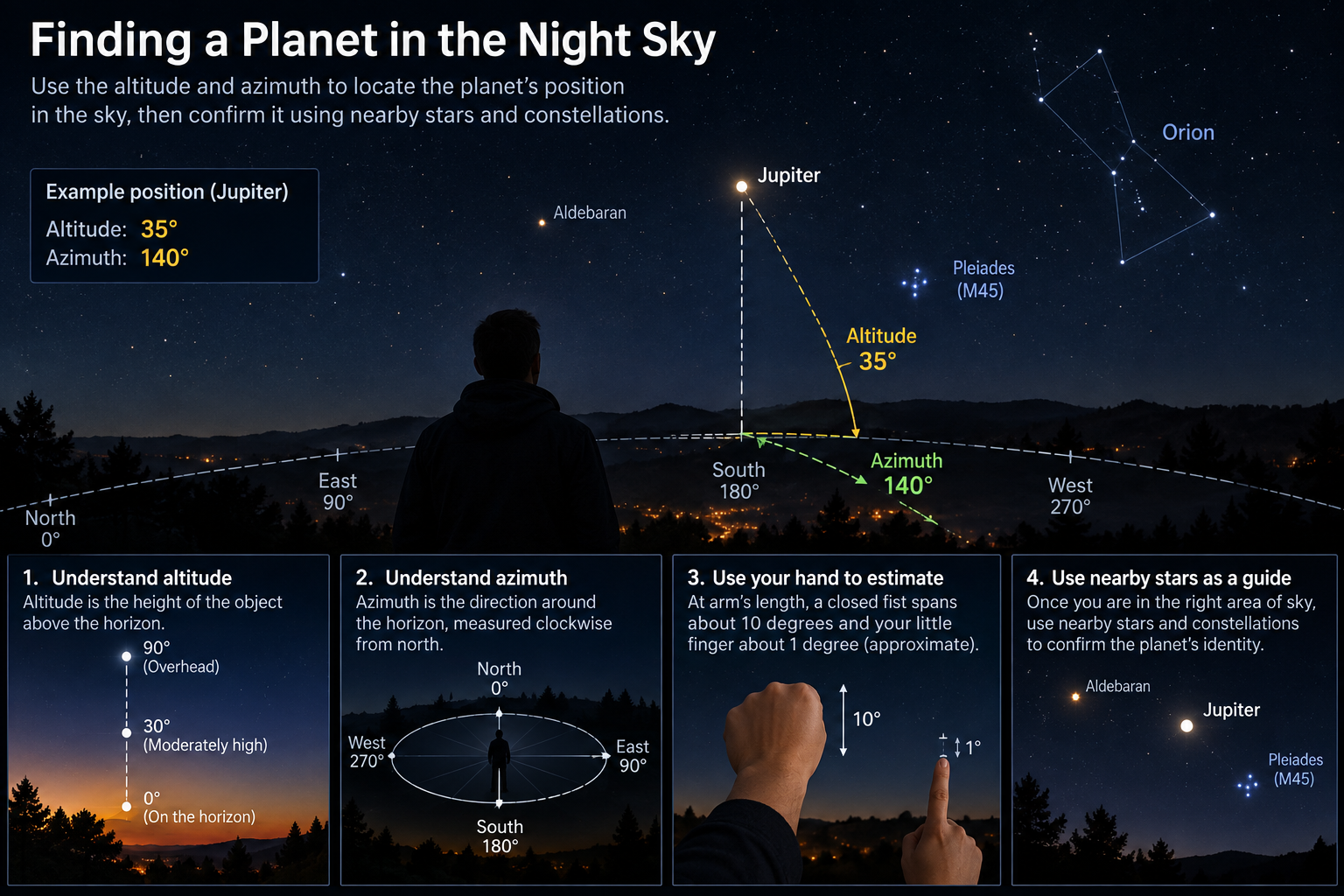
The challenge is usually not seeing a planet, but knowing that the point of light you are looking at really is one.
Once you understand where planets appear, how they differ from stars and how to use basic position information such as altitude and azimuth, identifying them becomes much easier.
Why do the planets appear in the same part of the sky?
The planets of the Solar System orbit the Sun in broadly the same plane. From Earth, this means that the Sun, Moon and planets appear to follow approximately the same path across our sky.
This apparent path is called the ecliptic.
The planets don't lie exactly on the ecliptic because their individual orbits are inclined by differing amounts, but they remain relatively close to it. As a result, you don't normally need to search the entire sky for a planet.
If you are familiar with the constellations of the zodiac, you will find the planets travelling through this same general region.
Their positions change because both Earth and the other planets are continually moving around the Sun.
Planets are wanderers
The word “planet” comes ultimately from an ancient Greek term meaning wanderer.
The name is appropriate.
Stars maintain essentially the same patterns relative to one another during a human lifetime. Orion still has the same recognisable shape from one year to the next.
Planets are different.
Look at Mars tonight and make a note of its position among the surrounding stars. Return several weeks later and Mars will have moved.
Jupiter and Saturn do the same thing, although their apparent movement through the constellations is slower because they orbit much farther from the Sun.
Following this movement is one of the simplest astronomical observations you can make.
Which planets can I see without a telescope?
Five planets have been known since antiquity because they can be readily seen without optical equipment:
- Mercury can be bright but is difficult to observe because it always remains relatively close to the Sun.
- Venus is exceptionally bright and appears in either the evening or morning sky.
- Mars is particularly recognisable because of its orange-red colour.
- Jupiter is extremely bright and is often one of the most conspicuous objects in the night sky.
- Saturn is also visible to the naked eye, although it is normally less striking than Venus or Jupiter.
- Uranus can just reach naked-eye visibility under exceptionally dark skies and favourable circumstances, but binoculars are a much more practical way of finding it.
- Neptune is too faint to be seen without optical assistance.
Start with the current position
The easiest way to find a planet is to know approximately where it should be before you go outside.
Planet Summary provides the current position of the planets for your location. Two particularly useful values are altitude and azimuth.
Altitude tells you how high the planet is above the horizon.
An altitude of:
- 0° means the object is on the horizon.
- 30° means it is moderately high in the sky.
- 90° means it is directly overhead.
Azimuth tells you the direction around the horizon.
The principal directions correspond approximately to:
- 0° — North
- 90° — East
- 180° — South
- 270° — West
Suppose Planet Summary tells you that Jupiter has:
- Altitude: 35°
- Azimuth: 140°
You know to look towards the south-east and then approximately 35 degrees above the horizon.
You don't need to measure these angles precisely. They are simply a way of reducing an enormous sky to a much smaller area in which to search.
Estimating altitude with your hand
Your hand provides a convenient rough measuring device when held at arm's length.
A closed fist spans approximately 10 degrees of sky for many people. Your little finger is roughly one degree wide, while the span between your extended thumb and little finger is around 20–25 degrees.
These are only approximations because everyone's hands and arm lengths differ, but they are surprisingly useful.
If a planet is listed at an altitude of about 30 degrees, for example, start near the horizon and measure approximately three fist widths upwards.
Combine that with its azimuth and you should be looking in roughly the right place.
Do planets really not twinkle?
You may have heard the rule:
Stars twinkle; planets don't.
It is useful, but not absolute.
Stars are so distant that they appear essentially as point sources. Turbulence in Earth's atmosphere continually bends their light slightly, producing the familiar twinkling effect known as scintillation.
Planets are much closer and present tiny discs rather than true point sources. Light arriving from different parts of the disc is affected slightly differently by the atmosphere, tending to average out some of the scintillation.
Consequently bright planets often shine more steadily than nearby stars.
However, planets can twinkle, particularly when they are low above the horizon and their light must pass through a greater thickness of Earth's atmosphere.
Use steadiness as a clue rather than an infallible test.
Colour provides another clue
Several planets have characteristic colours when viewed with the naked eye.
- Mars is the most obvious, usually displaying an orange or reddish hue.
- Jupiter generally looks creamy white.
- Saturn can appear slightly yellow or golden.
- Venus is an intense white.
- Mercury can also appear white or slightly yellowish, although its low altitude means Earth's atmosphere often alters its apparent colour.
Colour is useful when combined with position and brightness, but shouldn't normally be used by itself to identify a planet.
Brightness can make identification easy
Venus and Jupiter are often so bright that identifying them is straightforward once you know which part of the sky to examine.
Venus in particular is frequently mistaken for something unusual because of its extraordinary brightness.
Its position provides the answer. Venus orbits closer to the Sun than Earth and therefore never appears arbitrarily far from the Sun in our sky. Depending upon its position in its orbit, you will see it either after sunset or before sunrise.
Jupiter can appear throughout a much larger portion of the night because its orbit lies outside Earth's.
Mars varies considerably in brightness according to its distance from us.
Saturn is usually less conspicuous, but still easily visible without optical aid when well positioned.
Use nearby stars and constellations
Once you know approximately where a planet should be, identify a bright star or recognisable constellation nearby.
These provide useful landmarks.
You might establish that a planet lies:
- “below and to the left of this bright star”
- or:
- “between these two recognisable groups of stars”.
This approach becomes increasingly important when looking for Uranus and Neptune, which don't immediately distinguish themselves from the surrounding stars.
Moving systematically from a recognisable star to your target is known as star hopping.
It is one of the most useful practical skills in observational astronomy.
Finding Mercury
Mercury requires a slightly different approach because it never travels very far from the Sun.
Look for it during favourable periods either low in the western sky after sunset or low in the eastern sky before sunrise.
A clear, unobstructed horizon is important.
Do not use binoculars or a telescope to search for Mercury while the Sun is above the horizon. Accidentally pointing an unfiltered optical instrument towards the Sun can cause permanent eye damage.
Wait until the Sun has completely set for evening observations.
Finding Venus
Venus is usually the easiest planet to recognise.
When favourably positioned it appears as an extraordinarily bright white point in the evening or morning sky.
If you see a brilliant “star” in the west after sunset or east before sunrise, Venus is an obvious candidate.
Check its current position to confirm the identification.
Because Venus is so bright, it can sometimes be seen before the sky is completely dark.
Finding Mars
Look for a moderately bright to very bright object with a distinctly warm, orange-red colour.
Mars's brightness varies substantially as Earth and Mars move around the Sun, so it will not always be as conspicuous as you might expect.
Its colour is usually the best initial clue.
Once identified, watch Mars over several weeks and you should be able to detect its movement against the background stars.
Finding Jupiter
Jupiter is usually unmistakable when well placed.
It appears as a brilliant, creamy-white point of light and is commonly one of the brightest objects visible after the Moon and Venus.
Once you've found it, binoculars provide an excellent confirmation.
Hold them steadily and you may see several tiny points arranged in a line close to Jupiter. These are some of the four large Galilean moons: Io, Europa, Ganymede and Callisto.
Their positions change noticeably from night to night and sometimes during a single evening.
Finding Saturn
Saturn isn't normally as bright as Jupiter, which can make initial identification more difficult.
Look for a relatively bright, steady point with a slightly yellowish or golden appearance.
The definitive confirmation comes through a telescope.
Even a modest instrument can reveal Saturn's ring system, immediately removing any uncertainty about the planet's identity.
Finding Uranus
Finding Uranus requires more preparation.
Although it can technically become visible to the naked eye under exceptional conditions, binoculars are much more practical.
Use accurate current position information together with a detailed star chart. Identify a nearby bright star and work systematically towards Uranus.
At binocular magnification it will probably resemble a faint star.
A telescope at sufficient magnification reveals a tiny blue-green disc and provides much stronger confirmation that you've found the correct object.
Finding Neptune
Neptune requires optical assistance.
Use a detailed chart and accurate position information to locate its surrounding star field. Begin at low magnification and identify the stars around its expected position.
Once you have identified the likely planet, increase the magnification.
Under suitable conditions a telescope will show Neptune as a very small blue or blue-grey disc rather than a stellar point.
For both Uranus and Neptune, observing the same area on different nights can provide additional confirmation because the planet will slowly move relative to the background stars.
Rise, transit and set times
Knowing when a planet rises and sets helps you decide when to observe it.
A planet immediately after rising will be close to the horizon. Even though it is technically visible, buildings, trees, hills and atmospheric haze may make observation difficult.
As it rises higher, conditions usually improve.
A particularly useful time is around transit, when the planet crosses the observer's local meridian and generally reaches its greatest altitude for that particular passage across the sky.
Higher altitude means that the planet's light travels through less of Earth's atmosphere. This normally produces a clearer and steadier telescopic image.
If you have a choice of observing times, try to observe a planet when it is reasonably high rather than immediately after rising or shortly before setting.
What if I can't find the planet?
First check whether it is actually above your horizon.
Then consider the Sun. A planet can be geometrically above the horizon but impossible to see because it is in daylight or too close to the Sun.
Check the altitude. If it is only a few degrees above the horizon, a distant building or tree may be hiding it.
Cloud, haze and light pollution can also make less prominent planets difficult to see.
Finally, make sure you are using position information for the correct location and time.
Don't be discouraged. Learning the sky involves gradually becoming familiar with directions, brightnesses and patterns.
Each successful identification makes the next one easier.
You don't need a telescope to begin
It is easy to assume that astronomy starts with buying a telescope.
It doesn't.
Your eyes are excellent astronomical instruments. Learning to identify Venus, Mars, Jupiter and Saturn without optical assistance teaches you much more about the sky than immediately relying on a telescope.
Binoculars are an excellent next step because they are intuitive to use and show a relatively large area of sky.
A telescope becomes most useful once you have found the planet and want to see it as a world: the phases of Venus, the surface markings of Mars, Jupiter's cloud belts and moons, or Saturn's rings.
Follow the planets rather than observing them once
One of the most rewarding ways to understand planetary motion is to keep looking.
Choose a planet and observe it every few nights. Notice its position relative to nearby stars and make a simple sketch or record.
After several weeks the movement becomes obvious.
You may eventually observe apparent retrograde motion, when an outer planet temporarily appears to reverse its usual direction against the stars. The planet has not actually reversed its orbit. The effect results from the changing relative positions of Earth and the planet as both travel around the Sun.
Observing this yourself transforms something that can seem abstract in a diagram into a phenomenon happening in the real sky.
Start with the brightest planets
If you are new to observing, don't begin with Neptune.
Start with whichever of Venus, Mars, Jupiter or Saturn is currently well placed.
Use Planet Summary to find its direction and altitude, go outside and identify it with the naked eye.
Then return on another night.
Once you are comfortable recognising the brighter planets, try Mercury. Then use binoculars or a telescope and a star chart to tackle Uranus and Neptune.
There is no need to learn the whole night sky at once.
Planetary observation begins with a much simpler skill: knowing where to look. Once you can relate the position information on Planet Summary to the real sky above you, those anonymous points of light begin to become individual worlds — and the changing arrangement of those worlds becomes something you can follow for yourself.