Why Planets Appear to Move Across the Sky
Watch a planet for a few hours and it appears to travel steadily across the sky. Observe the same planet over several weeks and something else becomes apparent: its position amongst the background stars gradually changes as well.
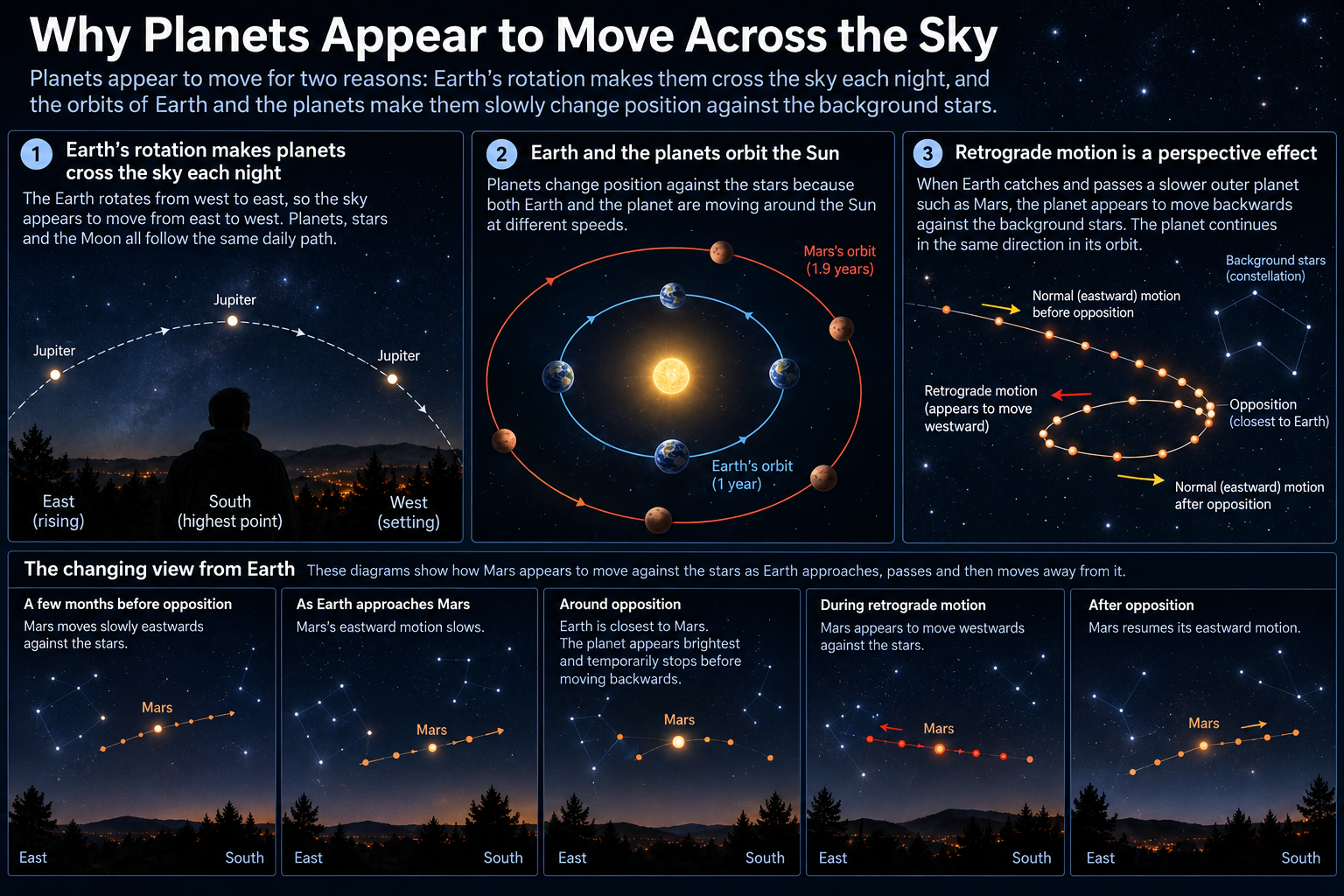
These are two different kinds of apparent motion, produced by two different causes.
The movement we see during a single night is primarily caused by the rotation of the Earth. The slower movement of a planet against the stars over days, weeks and months is produced by the orbits of both Earth and the planet around the Sun.
Understanding the difference provides one of the keys to understanding how the night sky works.
Why does the whole sky appear to move?
Earth rotates on its axis approximately once every 24 hours.
We are standing on that rotating Earth, but because we don't normally sense its movement, it appears to us as though the sky itself is turning in the opposite direction.
Earth rotates from west to east. Consequently the Sun, Moon, planets and stars generally appear to move across our sky from east to west.
This is why the Sun appears to rise in the east and set in the west. The same basic principle applies to the planets.
When you watch Jupiter move from the eastern sky, through the south and eventually towards the western horizon, it isn't Jupiter travelling around Earth during the night. Much of the apparent movement is the result of you being carried around by the rotation of Earth.
How quickly does the sky move?
Earth completes approximately one rotation relative to the stars in just under 24 hours.
A complete circle contains 360 degrees, so the sky appears to move at roughly:
15 degrees per hour
because:
360° ÷ 24 ≈ 15° per hour
This provides a useful rule of thumb when observing.
If a planet is comfortably above the eastern horizon, you can expect its position to have changed considerably a few hours later.
This movement is also why the altitude and azimuth values shown by Planet Summary continually change throughout the night.
The planet hasn't suddenly altered its orbit. Your observing position on the rotating Earth has changed relative to it.
Rising, crossing the sky and setting
For many observers, a planet begins an observing session by rising somewhere in the eastern part of the sky.
Its altitude gradually increases as Earth rotates. Eventually the planet reaches the highest point of its daily path across the sky.
This is known as transit, or more precisely meridian transit.
After transit, the planet's altitude decreases until it eventually sets towards the western part of the horizon.
The exact path depends on several factors, particularly the observer's latitude and the planet's position on the celestial sphere.
A planet therefore doesn't necessarily rise exactly in the east or set exactly in the west.
Why is a planet usually best observed when it is high in the sky?
A planet may technically be visible immediately after it rises, but that doesn't necessarily make it a good time for telescopic observation.
Near the horizon, its light has to travel through a much greater thickness of Earth's atmosphere.
Atmospheric turbulence can make the image shimmer and distort. Haze, dust and moisture can reduce contrast, while atmospheric refraction can introduce noticeable colour effects.
As the planet rises higher, we look through less atmosphere and the image will often improve.
This is why planetary observers generally prefer to observe a planet when it is reasonably high in the sky, particularly around the time it reaches its greatest altitude.
Planet Summary's altitude information can therefore tell you more than simply where to look — it can help you decide when to observe.
But planets also move amongst the stars
Earth's rotation explains what happens over the course of a night, but it doesn't explain everything.
Find Mars and note exactly where it appears relative to nearby stars. Look again several weeks later and Mars will have moved.
This happens because Mars is genuinely changing position relative to Earth as both planets orbit the Sun.
The same applies to all the other planets.
This slower motion is where the word planet gets its meaning. It derives from an ancient Greek word associated with wandering, reflecting the way these objects appeared to wander amongst the otherwise fixed patterns of stars.
Why do the stars appear fixed?
The stars are moving too.
Our Sun and the other stars of the Milky Way are travelling through space, and stars have their own individual motions.
However, the stars are extraordinarily distant compared with the planets.
Over the timescale of an ordinary observing session — or even a human lifetime in most cases — their movement relative to one another is so small that the familiar constellation patterns appear essentially unchanged.
The planets are vastly closer.
Their orbital movement therefore produces an easily detectable change in position against this apparently fixed stellar background.
This gives us a convenient reference system against which planetary motion can be observed.
The planets orbit at different speeds
The planets don't all travel around the Sun at the same rate.
- Mercury, the innermost planet, completes an orbit in only about 88 Earth days.
- Earth takes approximately one year.
- Mars requires about 687 Earth days.
- Jupiter takes nearly 12 Earth years, while Saturn requires about 29½ years.
- Uranus takes roughly 84 years and Neptune about 165 years to complete an orbit.
This means the inner planets change their positions much more rapidly than the distant outer planets.
Mercury can move through its observing cycle relatively quickly, while Neptune progresses extremely slowly through the constellations.
Why do Mercury and Venus behave differently?
Mercury and Venus orbit closer to the Sun than Earth does.
They are therefore known as inferior planets.
From Earth we can never see either of them directly opposite the Sun in the night sky. Instead they remain within a limited angular distance of the Sun.
Sometimes they appear to the east of the Sun and are visible after sunset.
At other times they appear west of the Sun and are visible before sunrise.
As their orbital positions change, they move back towards the Sun from our perspective, disappear into its glare and later emerge on the other side.
This is why Venus alternates between its familiar roles as the brilliant “evening star” and “morning star”.
Mercury follows the same basic pattern but remains much closer to the Sun in our sky and is consequently more difficult to observe.
The outer planets behave differently
Mars, Jupiter, Saturn, Uranus and Neptune orbit farther from the Sun than Earth.
These are known as superior planets.
Unlike Mercury and Venus, they can appear opposite the Sun in our sky.
When an outer planet is approximately opposite the Sun as viewed from Earth, it is said to be at opposition.
Around opposition the planet rises approximately as the Sun sets, remains visible for much of the night and reaches its highest point around the middle of the night.
It is also relatively close to Earth around this part of its observing cycle, making opposition particularly important for observers of Mars and the more distant planets.
Why does a planet sometimes appear to go backwards?
One of the most interesting planetary movements is retrograde motion.
Normally an outer planet gradually moves eastwards relative to the background stars.
Around opposition, however, it appears to slow down, stop and begin moving in the opposite direction.
After a period of this backwards or westward movement, it slows again, stops and resumes its normal eastward progress.
The planet hasn't actually reversed direction in its orbit.
The effect is produced by the changing viewpoint from Earth.
Understanding retrograde motion
Imagine two cars travelling around a circular racetrack in the same direction.
Your car is on an inside lane and travelling faster than a car on an outside lane.
As you approach and overtake the slower car, its position against distant objects beyond the track appears to shift backwards.
The other car hasn't reversed. The apparent backwards movement is caused by your own changing position relative to it.
Something similar happens with Earth and the outer planets.
Earth travels around the Sun more quickly than Mars, Jupiter, Saturn, Uranus and Neptune.
As Earth catches and passes one of these planets, our line of sight changes. Against the distant stellar background, the planet temporarily appears to move backwards.
Once Earth has moved sufficiently far ahead, the planet resumes its usual apparent direction.
Retrograde motion puzzled early astronomers
This backwards movement was one of the great problems faced by ancient models of the Solar System.
If the planets simply travelled around Earth in straightforward circular paths, why would they occasionally slow down, reverse direction and then move forwards again?
Complex systems of circles upon circles were developed to reproduce the observed movement.
The heliocentric model — with Earth and the other planets orbiting the Sun — provides a much more natural explanation.
Retrograde motion isn't a peculiar manoeuvre performed by a planet. It is a perspective effect produced by observing the Solar System from another moving planet.
You can watch this effect for yourself.
How to observe planetary motion
Choose a bright planet such as Mars, Jupiter or Saturn and identify several nearby stars.
Make a simple sketch showing the position of the planet amongst those stars.
You don't need artistic ability. Just mark the brighter stars and place the planet accurately relative to them.
Record the date.
Repeat the observation every few nights.
After a couple of weeks you should begin to see the planet's changing position clearly.
Continue for several months and, if the timing is appropriate, you may record part or all of a retrograde loop.
Photography provides another approach. Take images of the same area of sky at regular intervals and compare them.
The stars remain essentially fixed while the planet moves between them.
Why don't we notice this movement immediately?
Planetary orbital motion is normally much slower than the apparent movement caused by Earth's rotation.
During a single evening, Jupiter might travel a large distance across your sky from east to west because Earth is rotating beneath you.
Its movement relative to the nearby stars during those same few hours is comparatively small.
This gives us two very different timescales:
- Hours: the planet appears to cross the sky mainly because Earth is rotating.
- Days and weeks: the planet gradually moves relative to the stars because Earth and the planet are orbiting the Sun.
Keeping these two movements separate makes planetary position information much easier to understand.
Why are planets sometimes not visible at all?
A planet can spend weeks or months as a prominent object and then apparently disappear.
It hasn't stopped reflecting sunlight or vanished from the Solar System.
Instead, the orbital geometry has placed it too close to the Sun in our sky.
A planet near the Sun may be above the horizon during daylight, when the bright sky prevents us from seeing it, or it may rise and set so close to the Sun that it is lost in twilight.
As the planets continue moving around their orbits, the angular separation eventually increases and the planet becomes observable again.
For Mercury and Venus this cycle occurs regularly as they alternate between morning and evening appearances.
The outer planets undergo their own cycle, progressing from favourable nighttime visibility towards conjunction with the Sun and eventually returning to the morning sky.
Why planets don't rise at the same time every night
If Earth's rotation were the only movement involved, a planet would return to exactly the same place in our sky at the same clock time every night.
But Earth has also moved along its orbit during the intervening day, and the planet itself has moved along its own orbit.
The geometry has therefore changed slightly.
This is why planetary rise, transit and set times gradually change from one night to the next.
Over weeks and months the accumulated difference becomes substantial.
A planet that is visible in the evening during one part of the year may eventually become primarily a morning object or disappear temporarily into the Sun's glare.
A Solar System in constant motion
It is tempting to think of the night sky as a fixed backdrop, with stars and planets placed at particular coordinates.
In reality, almost everything is moving.
- Earth rotates on its axis.
- Earth travels around the Sun.
- The other planets travel around the Sun at different speeds and distances.
- Their moons orbit them.
- The Sun itself moves through the Milky Way.
- The stars of the Milky Way have their own motions.
What we see in the sky is the constantly changing result of all these movements viewed from the surface of our own moving planet.
The position information shown by Planet Summary is therefore a snapshot — the location of a planet from your observing position at a particular moment.
Watch for a few hours and Earth's rotation changes that position dramatically.
Return over several nights and the planet's orbital movement begins to reveal itself.
Continue observing for months and you can follow substantial portions of its journey through the constellations.
That is one of the great attractions of planetary observation. You don't need to take the motion of the Solar System on trust. With nothing more sophisticated than your eyes, a few familiar stars and a little patience, you can watch it happening for yourself.