Understanding Altitude and Azimuth
When you want to find a planet in the night sky, knowing its astronomical coordinates may sound complicated. In practice, two of the most useful measurements — altitude and azimuth — describe something very simple:
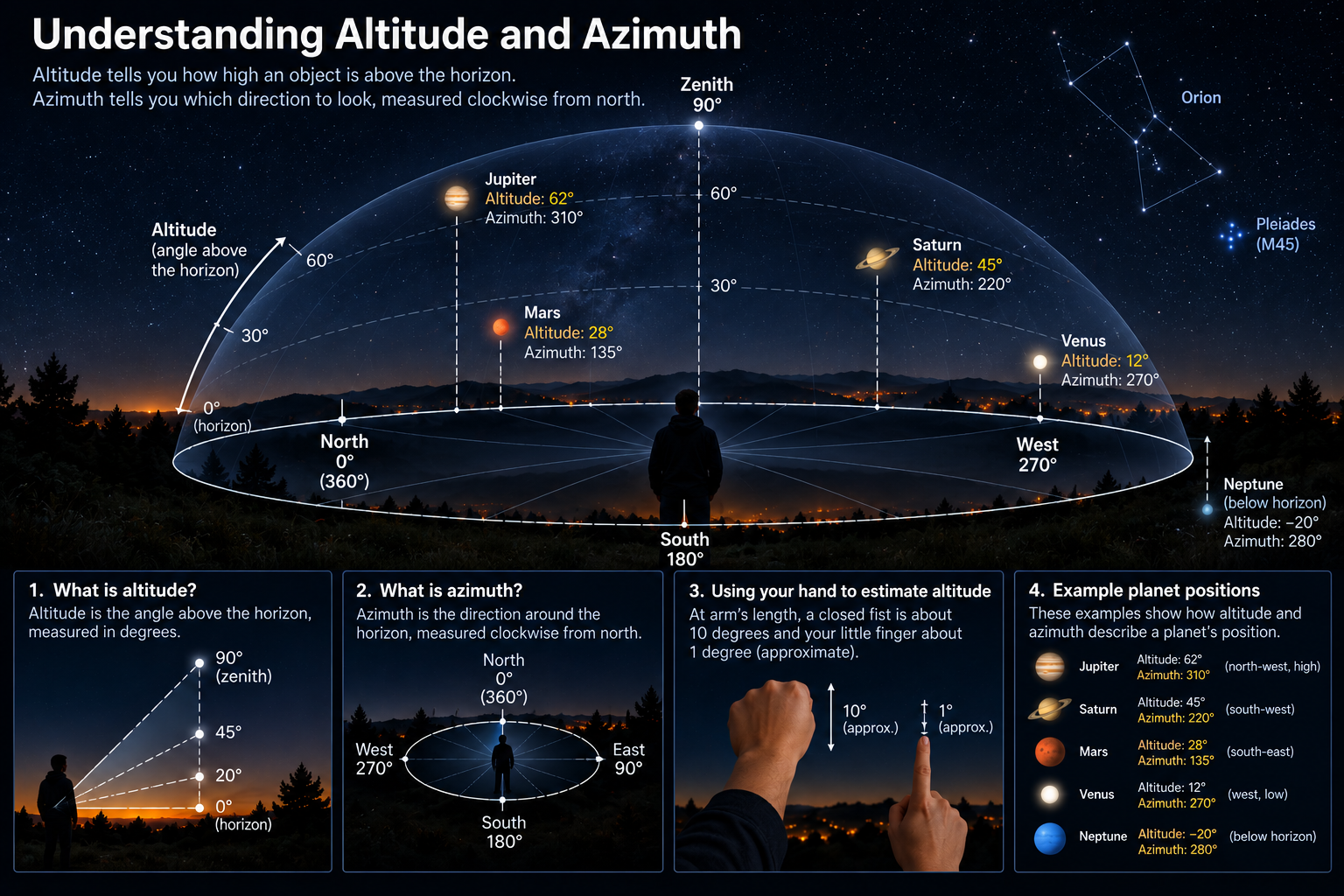
Which direction should I face, and how high should I look?
Azimuth tells you the direction around the horizon.
Altitude tells you the angle above the horizon.
Together they provide an intuitive way of describing the position of a planet, the Moon, the Sun or almost any other object in the sky from your particular location.
Once you understand these two measurements, the position information shown by Planet Summary becomes something you can use immediately when you step outside.
What is altitude?
Altitude describes how high an object appears above the horizon.
It is measured as an angle in degrees.
An object exactly on the horizon has an altitude of:
0°
An object halfway between the horizon and the point directly overhead has an altitude of:
45°
An object directly overhead has an altitude of:
90°
The point directly overhead has its own astronomical name: the zenith.
So if Planet Summary tells you that Jupiter has an altitude of 35°, you need to look 35 degrees above your local horizon.
What does a negative altitude mean?
Sometimes Planet Summary may show a negative altitude.
This simply means that the planet is below your horizon.
For example:
Altitude: −20°
means the planet is geometrically 20 degrees below the horizon from your location.
You won't be able to see it at that moment.
As Earth rotates, the altitude may increase until the planet eventually reaches 0°, corresponding approximately to the time of astronomical rising.
The planet then continues gaining altitude as it climbs into your sky.
Later, after reaching its highest point, the altitude decreases again until it returns to 0° at setting and subsequently becomes negative.
Altitude therefore provides a useful way of following a planet's progress across the sky.
What is azimuth?
Altitude tells you how high to look, but it doesn't tell you which direction to face.
For that we use azimuth.
Azimuth is an angle measured around your horizon, beginning at north and increasing clockwise.
The four principal compass directions correspond to:
- North — 0°
- East — 90°
- South — 180°
- West — 270°
A complete turn brings you back to north at 360°, which is equivalent to 0°.
This means that an azimuth of 90° tells you to look due east, while an azimuth of 180° means due south.
Values between these angles describe intermediate directions.
Converting azimuth into a direction
You don't normally need to measure azimuth with great precision.
For practical observing, it is often sufficient to translate the number into a familiar compass direction.
For example:
- 45° — north-east
- 90° — east
- 135° — south-east
- 180° — south
- 225° — south-west
- 270° — west
- 315° — north-west
Suppose Planet Summary gives Mars a position of:
Altitude: 28°
Azimuth: 135°
The instructions are effectively:
Face south-east and look about 28 degrees above the horizon.
That immediately reduces the whole sky to a relatively small area in which to search.
Using altitude and azimuth together
Neither value completely describes the planet's position on its own.
Consider:
Altitude: 40°
This tells you the planet is reasonably high in the sky, but it could be in any direction.
Now consider:
Azimuth: 220°
You know to look towards the south-west, but you don't know whether the planet is close to the horizon or almost overhead.
Combine them:
Altitude: 40°
Azimuth: 220°
and you have a specific position in the south-western sky.
This combination of altitude and azimuth forms what astronomers call the horizontal coordinate system.
It is particularly useful for observers because it describes the sky relative to the horizon they actually see.
Your horizon is the starting point
Astronomical altitude is measured from an ideal horizon.
In the real world your horizon may contain houses, trees, hills and other obstructions.
If a planet has an altitude of 3°, for example, it is technically above the astronomical horizon but may still be completely hidden from your observing position.
Learning your local horizon is therefore extremely useful.
You may discover that from your garden:
- the eastern horizon is blocked below 12° by houses,
- the southern horizon is clear almost to 5°,
- and trees obscure the west below 20°.
Once you know this, Planet Summary's altitude information becomes even more practical.
A planet at 8° altitude in the east might not yet be visible from your garden, while the same altitude towards the south could provide an unobstructed view.
Estimating altitude using your hand
You don't need a specialised instrument to estimate altitude.
Your hand can provide a useful approximation when held at arm's length.
For many people:
- Little finger width — about 1°
- Three middle fingers together — about 5°
- Closed fist — about 10°
- Span from thumb to little finger — roughly 20–25°
These values vary from person to person, so they shouldn't be treated as precise measurements.
They are nevertheless remarkably useful for finding objects.
Suppose Jupiter is at an altitude of 30°.
Face the correct azimuth, place the bottom of your fist approximately on the horizon and count upwards about three fist widths.
You should now be looking in approximately the right area.
Once you identify the planet, the exact measurement becomes unnecessary.
Finding azimuth with a compass
A conventional magnetic compass can provide an approximate azimuth.
If Planet Summary gives an azimuth of 150°, use the compass to face roughly that direction and then use the altitude value to determine how far above the horizon to look.
Most smartphones also contain compass sensors and can provide a convenient directional reference.
There is an important distinction, however.
Astronomical azimuth normally uses true north, while a traditional compass responds to magnetic north.
The difference between true and magnetic north is called magnetic declination, and its size varies according to your location.
For casual planet finding, a small difference is rarely important because bright planets are easy to identify once you're looking in approximately the correct area.
For more precise work, the distinction should be taken into account.
Why altitude and azimuth continually change
Look at Jupiter's position on Planet Summary and then check again an hour later.
Both altitude and azimuth will normally have changed.
The main reason is Earth's rotation.
As Earth turns, the celestial sphere appears to move across our sky. A planet rises, climbs higher, crosses the sky and eventually sets.
Its altitude therefore increases and later decreases.
Its azimuth also changes as it travels from one part of the horizon to another.
This is why altitude and azimuth describe an object's position at a particular time and from a particular location.
They are not permanent coordinates attached to the planet.
Why your location matters
Two observers at different locations can see the same planet at different altitudes and azimuths at the same moment.
Imagine one observer in northern Europe and another in southern Africa.
Both may be looking at Jupiter at exactly the same instant, but Jupiter will occupy a different position relative to each observer's horizon.
Their geographical latitude and longitude are different, so their orientation relative to the planet is different.
This is why Planet Summary uses your location when calculating positional information.
Altitude and azimuth only become meaningful when they are associated with both a place and a time.
Altitude also tells you something about observing quality
Altitude isn't only useful for locating a planet.
It can also help you decide whether it is worth observing now or waiting until later.
When a planet is close to the horizon, its light must pass through a relatively long path through Earth's atmosphere.
This can cause:
- increased atmospheric turbulence,
- poorer image sharpness,
- stronger colour distortion,
- reduced contrast,
- and greater effects from haze and pollution.
As the planet climbs higher, its light generally passes through less atmosphere.
For telescopic planetary observation, this can result in a substantially clearer and steadier image.
A planet at 50° altitude will usually provide better observing conditions than the same planet at 10°, assuming other conditions are similar.
What is a good altitude for observing?
There is no single altitude at which a planet suddenly becomes “good” to observe.
Generally, though, higher is better.
Below about 10° the atmosphere can have a severe effect on the view.
Between roughly 10° and 20°, observation is certainly possible, particularly for bright planets, but atmospheric distortion may remain significant.
Above about 30°, conditions are generally more favourable.
If a planet reaches 50°, 60° or higher from your location, it can be exceptionally well placed for telescopic observation when atmospheric conditions are steady.
This doesn't mean you shouldn't look at a planet when it is low.
A low planet is considerably better than a planet hidden behind cloud — and sometimes a low-altitude observation is the only opportunity available.
Altitude simply helps you understand what to expect.
What happens at transit?
As a planet travels across the sky, it eventually crosses your local meridian.
This event is known as meridian transit.
At its usual upper transit, the planet generally reaches its greatest altitude for that particular passage across the sky.
This makes the period around transit particularly useful for telescopic observers.
Suppose Saturn rises at 19:30 but only reaches an altitude of 8° initially.
By 22:00 it might have reached 30°.
At transit around midnight it might reach 43°.
If your aim is to obtain the clearest possible telescopic view, observing around midnight would probably be preferable.
Planet Summary's rise, set and position information can help you plan accordingly.
Why some planets never get very high
A planet's maximum altitude depends partly on its declination, which describes its position north or south of the celestial equator, and partly on your own latitude.
This means the same planet may pass high overhead for observers in one part of the world while remaining comparatively low for observers elsewhere.
The effect changes as planets move through different parts of their orbits and consequently through different areas of the celestial sphere.
This is one reason some planetary observing opportunities are more favourable than others even when the planet is otherwise close to Earth.
A high passage across the sky can provide excellent observing conditions, while a low passage may leave observers looking through a large amount of turbulent atmosphere all night.
What happens at the zenith?
The zenith is the point exactly above you.
Its altitude is 90°.
Something interesting happens to azimuth at precisely this point.
At the zenith, every horizontal direction leads away from the same overhead point, so azimuth effectively becomes undefined.
In practice this rarely causes difficulty when observing planets, since a planet passing exactly through an observer's zenith requires a particular combination of the planet's declination and the observer's latitude.
But it illustrates an important property of the altitude-azimuth system: it is based entirely upon the observer's local horizon.
Altitude and azimuth versus astronomical coordinates
You may also encounter coordinates called right ascension and declination.
These describe positions relative to the celestial sphere rather than your local horizon.
They are extremely useful for star charts, telescopes and astronomical catalogues because they don't change rapidly as Earth rotates.
Altitude and azimuth serve a different purpose.
If someone tells you:
Right ascension: 5h 12m
Declination: +22°
you need some astronomical knowledge or equipment to translate that into a direction in your local sky.
If Planet Summary tells you:
Azimuth: 135°
Altitude: 35°
the practical meaning is immediate:
Look south-east, 35° above the horizon.
For finding a planet with your own eyes, altitude and azimuth are therefore particularly intuitive coordinates.
A practical example
Imagine Planet Summary shows:
Jupiter
Altitude: 32°
Azimuth: 145°
First consider the azimuth.
145° lies between east at 90° and south at 180°, so Jupiter is in the south-eastern sky.
Face south-east.
Now consider the altitude.
32° is roughly three fist widths above the horizon when measured at arm's length.
Look in that area.
Jupiter is bright, so once you're facing the correct direction and looking at approximately the correct height, identifying it should usually be straightforward.
Check again two hours later and you might find:
Altitude: 48°
Azimuth: 175°
Jupiter has moved higher and is now almost due south.
Nothing mysterious has happened to Jupiter. Earth's rotation has changed your viewpoint.
Use the numbers as a guide, not a test
You don't need to stand outside attempting to measure an azimuth of exactly 147.3° and an altitude of precisely 36.8°.
That isn't the purpose of the information.
Think of altitude and azimuth as directions:
Which way?
and:
How high?
For bright planets, approximate values are usually enough to get you into the correct part of the sky.
Then use brightness, colour, nearby stars and constellations to make the final identification.
For Uranus and Neptune, where the planets can resemble faint stars, more precise positioning and a detailed star chart become considerably more important.
Turning numbers into a real sky
At first, values such as:
Altitude: 37°
Azimuth: 212°
can look like abstract astronomical data.
But they describe something very tangible.
212° means turn towards the south-west.
37° means look a little under halfway from the horizon towards the point directly overhead.
There is your planet.
Watch it for an hour and the numbers change because Earth has rotated beneath the sky. Watch over several weeks and another change becomes apparent as Earth and the planet move along their respective orbits around the Sun.
This is where altitude and azimuth become more than coordinates.
They connect the calculations shown by Planet Summary with the sky above you, allowing you to take a numerical position, step outside and find another world for yourself.