Understanding Planet Rise and Set Times
Knowing when a planet rises and sets is one of the simplest ways to decide whether you can observe it on a particular night.
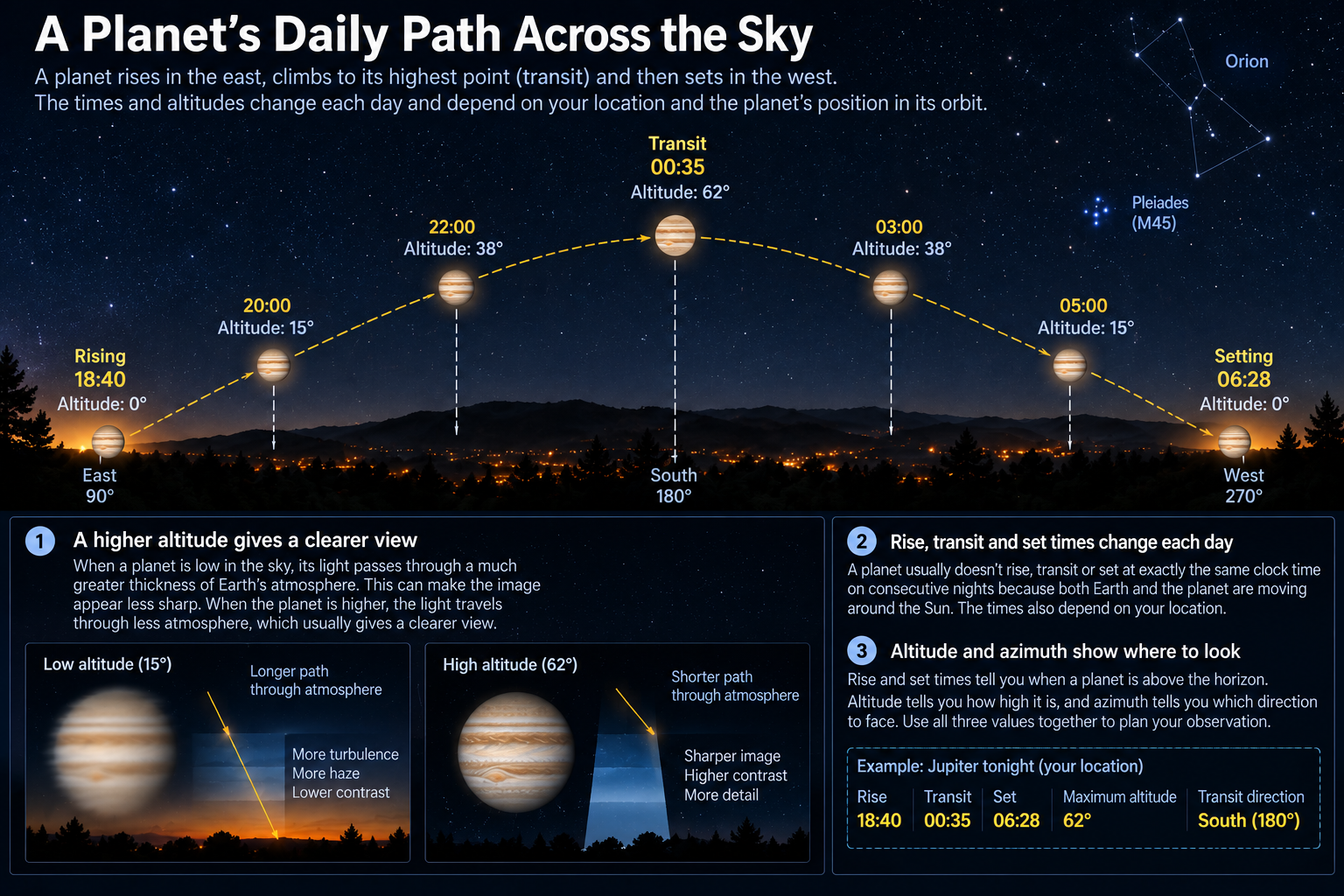
A planet may be in a favourable part of its orbit and shining brightly, but that doesn't necessarily mean it will be visible when you step outside. It might still be below your horizon, it may already have set, or it could be above the horizon during daylight when the brightness of the sky prevents you from seeing it.
Rise and set times help put a planet's position into practical terms. Together with its altitude, azimuth and the times of sunset and sunrise, they tell you when to look, which direction to face and often when you can expect the best view.
What does planet rise time mean?
A planet's rise time is the time at which it crosses the observer's eastern horizon and moves into the visible half of the sky.
This is a calculated astronomical horizon rather than necessarily the horizon you can actually see.
If Planet Summary shows that Jupiter rises at 20:15, for example, this means that at approximately 20:15 Jupiter crosses the theoretical horizon for your location.
It doesn't guarantee that you'll immediately be able to see it.
A hill, building or tree may block your view. Atmospheric conditions near the horizon may also make the planet difficult to detect.
For practical observation it is often better to wait until the planet has climbed some distance above the horizon.
What does set time mean?
The set time is the opposite.
It is the time at which the planet crosses the western horizon and leaves the visible half of the sky.
Again, your actual local horizon may be obstructed.
If Saturn is calculated to set at 01:30 but a row of houses blocks the western horizon from your observing position, you may lose sight of it considerably earlier.
Rise and set times should therefore be regarded as astronomical reference points rather than guarantees of visibility right up to the stated minute.
Why do planets rise in the east and set in the west?
The apparent daily movement of the planets is primarily caused by Earth's rotation.
Earth rotates from west to east. From our viewpoint on its surface, the celestial sphere therefore appears to move in the opposite direction.
The Sun, Moon, stars and planets consequently appear generally to rise in the eastern part of the sky, travel westwards and eventually set in the western part.
The planets are moving in their own orbits at the same time, but over the course of a single night Earth's rotation dominates their apparent movement across the sky.
This is the same reason the Sun appears to rise in the east each morning even though it is Earth that is rotating.
A planet doesn't necessarily rise exactly in the east
“Rises in the east” is a useful general description, but it shouldn't be taken to mean that every planet rises at an azimuth of exactly 90 degrees.
A planet may rise north of east or south of east and set correspondingly north or south of west.
Its precise rising and setting directions depend upon its position on the celestial sphere and your geographical latitude.
This is why Planet Summary provides azimuth as well as rise and set information.
Azimuth tells you where around your horizon an object lies, with north at 0 degrees, east at 90 degrees, south at 180 degrees and west at 270 degrees.
Knowing both the time and direction of a planet's appearance makes finding it considerably easier.
What happens between rise and set?
After rising, a planet generally climbs higher in the sky.
Its altitude increases until it reaches the highest point of its daily path. It then begins descending towards the opposite horizon before eventually setting.
For many observers in the Northern Hemisphere looking at planets that pass through the southern sky, the general pattern looks something like:
Rise in the east → climb into the southern sky → reach highest altitude → descend towards the west → set
The exact path varies according to the planet's celestial position and the observer's location.
The important point for observing is that a planet's height above the horizon changes continually between rising and setting.
What is transit?
The moment when a planet crosses your local meridian is known as its meridian transit.
For the usual upper transit, this is generally when the planet reaches its greatest altitude during that particular passage across the sky.
Transit is particularly useful to observers because a planet is often best viewed when it is reasonably close to its highest altitude.
The reason has nothing to do with the planet itself. It is Earth's atmosphere.
When a planet is close to the horizon, its light must travel through a much greater thickness of atmosphere before reaching you.
When the planet is high in the sky, the path through the atmosphere is shorter.
This can make an enormous difference when using a telescope.
Why planets are difficult to observe near the horizon
Look at a bright star close to the horizon and you may see it flicker rapidly and display flashes of colour.
The same atmospheric effects influence planets.
Near the horizon, atmospheric turbulence can distort a planet's image. Haze, dust and moisture reduce transparency, while atmospheric refraction can produce colour fringes and other distortions.
For naked-eye observation this may not matter very much.
For telescopic planetary observation it can be the difference between seeing fine detail and seeing little more than a shimmering blur.
If Jupiter rises at 21:00, therefore, 21:05 is unlikely to be the best time to point a high-powered telescope towards it.
Waiting until it has gained altitude will usually produce a better view.
Rise time does not mean visible time
This distinction is particularly important.
Imagine Venus rises at 07:00 but the Sun rises at 06:30.
Venus is technically above the horizon after 07:00, but it is rising into daylight. Depending upon the circumstances, it may be extremely difficult or impossible to see with the unaided eye.
Similarly, a planet could rise shortly before sunrise and have very little time to become visible against the brightening morning sky.
Conversely, if Jupiter rises several hours before sunset, it may be above the horizon during the afternoon but not become obvious until the sky darkens.
Astronomical rise time and practical visibility are therefore not the same thing.
Sunset and sunrise matter
To understand whether a planet will actually be observable, compare its rise and set times with sunset and sunrise.
Suppose Mars:
- rises at 19:30
- transits at 01:10
- sets at 06:45
and the Sun sets at 20:00.
Mars is already above the horizon when darkness begins. It continues climbing during the evening, reaches its highest point after midnight and remains above the horizon until morning.
That would provide a long observing window.
Now imagine Mercury:
- rises at 05:20
- Sun rises at 06:00
Although Mercury is technically above the horizon for forty minutes before sunrise, twilight may make the useful observing window considerably shorter.
This is one reason Mercury is much more difficult to observe than Jupiter or Saturn.
Twilight makes a difference
The sky doesn't become completely dark the instant the Sun sets.
After sunset we pass through several stages of twilight as the Sun moves progressively farther below the horizon.
Similarly, the sky begins brightening before sunrise.
Bright planets such as Venus and Jupiter can remain visible during fairly bright twilight. Fainter objects disappear much sooner.
When deciding whether a planet is observable, therefore, consider not only its rise and set times but also the brightness of the surrounding sky.
This is especially important for Mercury, which never appears very far from the Sun.
Why do rise and set times change every day?
A planet usually doesn't rise at exactly the same clock time on consecutive nights.
This is because two different kinds of motion are taking place.
Earth is rotating on its axis, producing the daily movement across the sky.
But Earth is also moving along its orbit around the Sun.
At the same time, the planet you are observing is moving along its orbit.
After one day, the relative positions of Earth, the Sun and the planet have therefore changed slightly.
The resulting rise, transit and set times change as well.
The difference may seem small from one night to the next, but over weeks and months it becomes substantial.
Why are some planets visible in the evening and others in the morning?
The answer is orbital geometry.
Mercury and Venus orbit closer to the Sun than Earth does.
From our viewpoint they always remain within a limited angular distance of the Sun. At some points in their observing cycles they appear east of the Sun and remain above the horizon after sunset, making them evening objects.
At other times they appear west of the Sun and rise before sunrise, making them morning objects.
The outer planets behave differently because their orbits lie beyond Earth's.
Mars, Jupiter, Saturn, Uranus and Neptune can eventually reach opposition, when they appear roughly opposite the Sun in our sky.
Around opposition an outer planet rises around sunset, remains visible through much of the night and sets around sunrise.
This is one reason opposition is such an important period for planetary observation.
Why can a planet sometimes be above the horizon all night?
Around opposition, an outer planet is positioned approximately opposite the Sun from our viewpoint.
As the Sun sets in the west, the planet rises in the east.
Around the middle of the night it reaches its highest point.
As sunrise approaches in the east, the planet sets towards the west.
This gives observers a particularly long opportunity to see it.
For planets such as Mars, opposition also places the planet relatively close to Earth, increasing its apparent size and brightness.
Why does a planet sometimes disappear for weeks?
There are periods when a planet becomes difficult or impossible to observe because it lies too close to the Sun in our sky.
This configuration is known generally as conjunction.
An outer planet approaching conjunction may set shortly after the Sun and become progressively harder to see in evening twilight.
Eventually it is lost in the Sun's glare.
Later it reappears on the other side of the Sun, initially as a morning object rising shortly before sunrise.
As the weeks pass, it rises progressively earlier and becomes easier to observe.
Nothing unusual has happened to the planet. The changing visibility simply reflects the changing positions of Earth and the planet in their respective orbits.
Your location matters
Rise and set times are specific to the observer.
Someone hundreds or thousands of kilometres away will have different times because their position on Earth's rotating surface is different.
Longitude has an obvious effect on local timing, while latitude influences the path an object follows through the sky and how long it remains above the horizon.
This is why using rise and set times calculated for your actual location is much more useful than relying upon times quoted in a general astronomy article or observing guide.
Planet Summary uses your selected location to present information relevant to the sky you can actually see.
Your horizon matters too
Astronomical calculations generally assume an idealised horizon.
The real world is rarely so cooperative.
From your observing position you may have:
- trees to the east,
- buildings to the south,
- hills to the west,
- or nearby structures blocking part of the sky.
You may therefore want to learn your own local horizon.
For example, you might discover that objects in the east don't become visible from your garden until they reach an altitude of about 12 degrees because neighbouring houses obscure everything below that level.
Once you know this, the altitude information provided by Planet Summary becomes particularly useful.
Refraction near the horizon
Earth's atmosphere bends light slightly.
This effect, known as atmospheric refraction, is strongest near the horizon.
As a result, the apparent position of an astronomical object close to the horizon can differ from its purely geometric position.
Astronomical rise and set calculations commonly take standard atmospheric refraction into account, although actual refraction varies according to atmospheric pressure, temperature and local conditions.
This is another reason not to regard a predicted rise or set time as an absolutely precise moment of practical visibility.
How to choose the best observing time
For casual naked-eye observation, you may simply need three pieces of information:
- Is the planet above the horizon?
- Is the sky dark enough?
- Which direction should I look?
For telescopic observation, add another question:
- How high will the planet be?
If you have several hours available, don't automatically observe as soon as the planet rises.
Look at how its altitude will change.
If Saturn is only 8 degrees above the horizon at 21:00 but will reach 35 degrees by midnight, the later observation is likely to provide a substantially better telescopic view.
On the other hand, if cloud is forecast to arrive at 23:00, taking the lower-altitude view may be better than seeing nothing at all.
Astronomical data helps you plan; the real sky still gets the final say.
An example observing plan
Imagine Planet Summary shows:
- Jupiter rises: 18:40
- Sunset: 19:25
- Jupiter transit: 00:35
- Jupiter sets: 06:28
You could interpret this as follows.
At sunset Jupiter is already above the horizon, but the sky is still bright.
As twilight progresses, Jupiter becomes increasingly obvious.
During the evening it continues gaining altitude.
Around 00:35 it reaches its greatest altitude and is likely to be particularly well placed for telescopic observation.
Afterwards it gradually descends towards the western horizon before setting in the morning.
Rather than simply knowing that “Jupiter is visible tonight”, you now have enough information to choose an observing time deliberately.
Use rise and set times together with altitude and azimuth
No single value tells the whole story.
Rise and set times tell you when the planet is above the horizon.
Altitude tells you how high it is.
Azimuth tells you which direction to look.
Sunset, sunrise and twilight tell you whether the sky is likely to be dark enough.
Used together, these values turn astronomical coordinates into practical observing information.
For example:
Mars is above the horizon
tells you very little.
But:
Mars is 42° high in the south-east, rising higher, with three hours until transit
immediately tells you that the planet is well placed and likely to improve further as the evening progresses.
Watch the pattern change
Try following the rise time of a particular planet over several weeks.
You don't even need a telescope.
Record its rise, transit and set times periodically and compare them with sunset.
You'll see the planet's observing window gradually shift.
Then go outside occasionally and confirm what the numbers predict.
You begin to see that rise and set times aren't simply timetable entries. They are the visible consequence of Earth rotating beneath the sky while Earth and the other planets simultaneously travel around the Sun.
Once you understand that relationship, the changing planetary information on Planet Summary becomes much more intuitive.
A rise time tells you when a world enters your sky. A set time tells you when it leaves. Everything between those two moments describes the path that world appears to take above your horizon — and helps you decide when to go outside and see it for yourself.