Understanding Planetary Conjunctions
Occasionally two bright planets appear remarkably close together in the sky. At other times a planet passes close to the Moon or seems to approach a bright star.
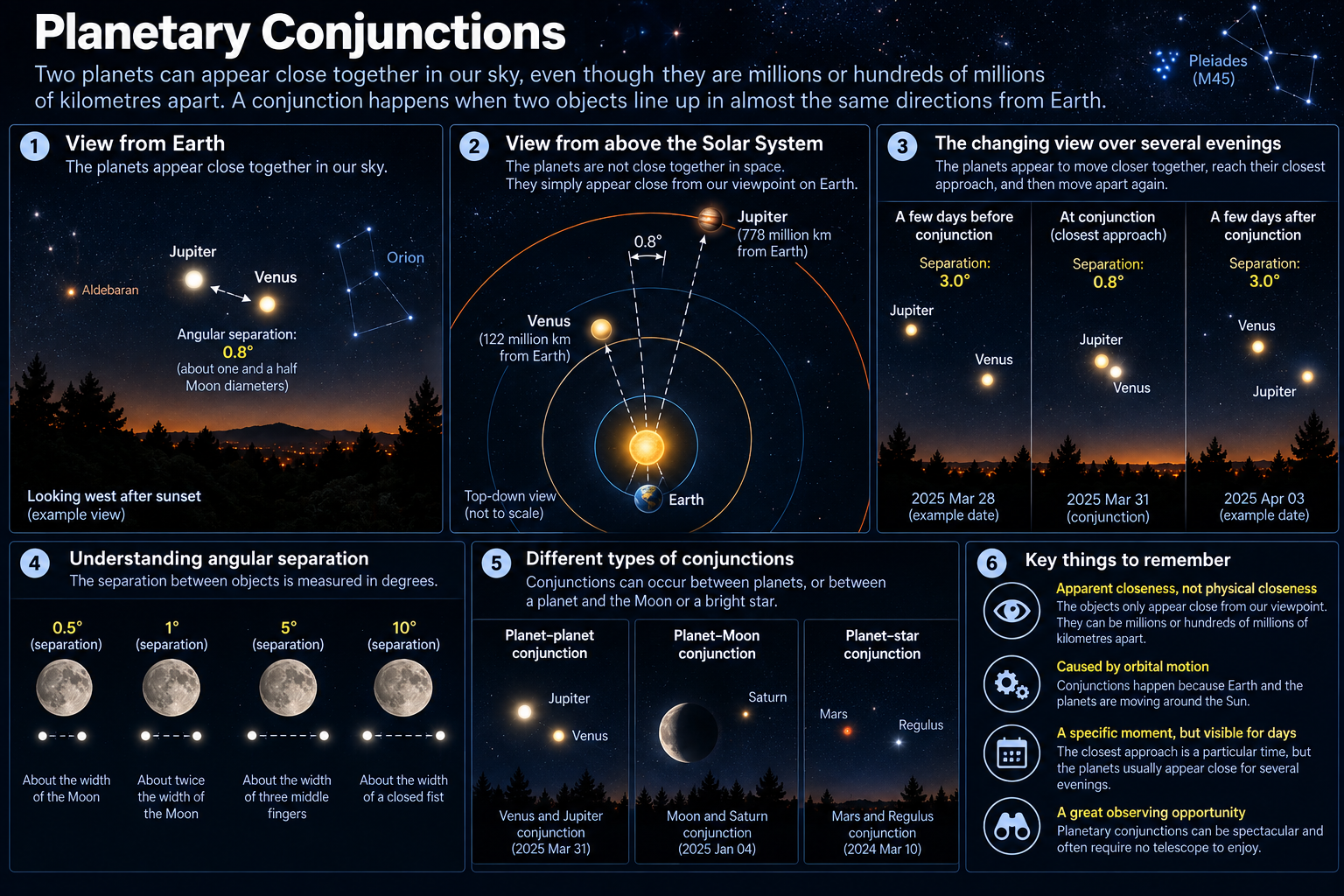
These events are known as conjunctions.
A conjunction can produce some of the most attractive sights in the night sky and often requires no telescope to enjoy. Venus and Jupiter shining together in the twilight, a crescent Moon passing close to Saturn, or Mars appearing alongside a bright star can all provide memorable observing opportunities.
The objects aren't actually close together in space. They simply appear close from our viewpoint on Earth.
Understanding why this happens provides another useful demonstration that the Solar System is constantly moving.
What is a conjunction?
In general astronomical terms, a conjunction occurs when two objects appear close together in the sky as viewed from Earth.
More precisely, astronomers usually define a conjunction according to one of the celestial coordinate systems used to describe positions in the sky. For example, two objects may be considered in conjunction when they share the same right ascension or the same ecliptic longitude.
For practical observation, however, the important point is much simpler:
Two astronomical objects appear unusually close together in our sky.
They might be two planets, a planet and the Moon, or a planet and another astronomical object.
Why do conjunctions happen?
Everything in the Solar System is moving.
Earth travels around the Sun.
The other planets travel around the Sun at different speeds and distances.
The Moon orbits Earth.
Because our viewpoint is constantly changing, the apparent positions of these objects against the background stars change as well.
Sometimes two objects happen to lie along nearly the same line of sight.
From Earth they then appear close together even though their actual distances from us may be enormously different.
This apparent closeness is what produces a conjunction.
Apparent closeness is not physical closeness
This is one of the most important things to understand about conjunctions.
Imagine standing in a field and seeing a nearby tree apparently next to a distant church tower.
From your viewpoint the two objects may appear almost to touch.
In reality they could be kilometres apart.
A planetary conjunction works in much the same way, but on an enormous scale.
Suppose Venus and Jupiter appear close together.
Venus might be relatively close to Earth while Jupiter lies hundreds of millions of kilometres farther away.
They aren't approaching one another physically.
They merely occupy almost the same direction in Earth's sky.
Measuring the separation
The apparent distance between objects in the sky is normally measured as an angular separation.
A complete circle contains 360 degrees.
The apparent diameter of the Moon is roughly half a degree.
So if two planets are separated by:
5°
they are approximately ten apparent Moon diameters apart.
At:
1°
they are separated by roughly twice the apparent width of the Moon.
At:
0.5°
they could appear close enough to fit within an area of sky comparable to the Moon's apparent diameter.
Very close conjunctions can therefore look spectacular to the unaided eye.
Estimating separation with your hand
As with altitude, your hand can provide a rough way to estimate angular distances in the sky.
Held at arm's length:
- Your little finger is roughly 1° wide.
- Three middle fingers together cover approximately 5°.
- A closed fist spans roughly 10°.
These values vary between individuals, but they are useful for making quick estimates.
If two planets are approximately one little-finger width apart, their angular separation is around a degree.
If they are half a fist apart, their separation is roughly five degrees.
Planet-planet conjunctions
Conjunctions between bright planets can be particularly impressive.
Venus and Jupiter are capable of producing spectacular pairings because both can be exceptionally bright.
Mars can add a distinctive reddish colour to a conjunction, while Saturn provides an interesting telescopic target if it participates.
Mercury also forms conjunctions, although observing them can be more difficult because Mercury always remains relatively close to the Sun.
Uranus and Neptune participate in conjunctions too, but their faintness means optical equipment is generally needed to observe them.
Conjunctions with the Moon
The Moon moves relatively quickly against the background stars, travelling around Earth in approximately a month.
It therefore regularly passes close to planets in our sky.
A thin crescent Moon close to Venus can be particularly beautiful, especially during evening or morning twilight.
The Moon can also provide a convenient signpost.
If you know that Jupiter is close to the Moon tonight, finding Jupiter becomes much easier because the Moon immediately guides you to the correct part of the sky.
However, the Moon's position changes noticeably from one night to the next, so such arrangements can be short-lived.
Conjunctions with stars
Planets can also appear close to bright stars.
Technically, the star is at an almost unimaginably greater distance than the planet.
The apparent pairing nevertheless creates an interesting visual event.
These encounters can be particularly useful for demonstrating planetary motion.
A star remains essentially fixed against the surrounding stellar pattern, while the planet changes position from night to night.
Observe several evenings before and after the conjunction and you can watch the planet approach the star, pass it and move away again.
How long does a conjunction last?
The precise conjunction is an astronomical instant, but the visual event usually lasts much longer.
Two planets may appear attractively close for several evenings.
A conjunction involving the Moon tends to change more quickly because the Moon moves relatively rapidly through our sky.
The best observing opportunity also depends upon factors such as sunset, sunrise, altitude and weather.
So don't assume that you must observe at the exact calculated moment of conjunction.
A clear evening a few hours before or after the formal event may provide an equally attractive — or even better — view.
Closest approach and conjunction are not always the same moment
This is an important distinction.
The formal astronomical conjunction is usually defined using celestial coordinates.
The moment when two objects have their smallest apparent angular separation is known as their closest approach.
These moments can occur at slightly different times.
For casual observation the distinction may be unimportant, but it explains why an astronomy service might list:
Conjunction: 20:15
and:
Closest approach: 21:03
for what appears to be the same event.
One describes a particular coordinate relationship; the other describes the moment when the objects appear closest together in the sky.
Can planets actually overlap?
From our viewpoint, yes.
If two objects pass sufficiently close to the same line of sight, one can appear to pass in front of the other.
When one astronomical body hides another, the event is generally known as an occultation.
The Moon frequently occults stars because its apparent disc covers a relatively large area of sky.
It can also occult planets.
A planet disappearing behind the dark edge of the Moon and later reappearing can be a fascinating telescopic event.
Planet-on-planet occultations are possible but extremely rare because planets occupy such tiny apparent areas of the sky.
A conjunction, therefore, does not normally mean one object will cover another. Most conjunctions simply bring the objects relatively close together.
Conjunctions are a matter of perspective
One of the most useful things about observing conjunctions is that they reveal the three-dimensional nature of the Solar System.
The sky can look like a dome on which stars and planets have been placed at different positions.
In reality, those objects are distributed across enormous distances.
During a conjunction, two objects temporarily line up from our particular viewpoint.
An observer somewhere else in the Solar System would see a different arrangement.
The conjunction is therefore not merely an event involving the two objects. It depends upon the observer's position as well.
What is conjunction with the Sun?
The term conjunction is also used when a planet appears close to the Sun in our sky.
For observers, this is very different from an attractive conjunction between two planets.
A planet near conjunction with the Sun is normally difficult or impossible to observe because it is lost in the Sun's glare.
The geometry differs depending upon whether the planet orbits inside or outside Earth's orbit.
Superior conjunction
Mercury and Venus can pass behind the Sun as viewed from Earth.
This arrangement is known as superior conjunction.
The approximate geometry is:
Earth — Sun — Planet
The planet lies on the far side of the Sun from us.
Around this time it is not normally observable because its apparent position is too close to the Sun.
As the orbital geometry changes afterwards, the planet eventually emerges from the Sun's glare and becomes visible again.
Inferior conjunction
Mercury and Venus can also pass between Earth and the Sun.
This is called inferior conjunction.
The arrangement is approximately:
Sun — Planet — Earth
Again, the planet is generally lost in the Sun's glare.
Occasionally the alignment is precise enough for Mercury or Venus to pass directly across the Sun's disc.
This is called a transit of Mercury or transit of Venus.
Such events require specialist safe solar observing techniques. The Sun must never be viewed directly through binoculars or a telescope without appropriate solar equipment.
Conjunction for the outer planets
Mars, Jupiter, Saturn, Uranus and Neptune cannot pass between Earth and the Sun because their orbits lie outside Earth's.
For these planets, conjunction with the Sun occurs when the planet lies approximately on the far side of the Sun.
The geometry is:
Earth — Sun — Planet
Around conjunction the planet becomes difficult or impossible to observe.
Before conjunction it gradually disappears into evening twilight.
After conjunction it eventually emerges into the morning sky, initially rising shortly before the Sun.
As the weeks pass, it rises earlier and becomes progressively easier to observe.
Conjunction and opposition
For an outer planet, conjunction and opposition represent approximately opposite parts of its observing cycle.
At conjunction:
Earth — Sun — Planet
The planet appears close to the Sun and is difficult to observe.
At opposition:
Sun — Earth — Planet
The planet appears opposite the Sun, rises around sunset and remains visible for much of the night.
This makes opposition particularly favourable for observing outer planets, while conjunction generally marks the least favourable part of their cycle.
Following a planet between these configurations provides an excellent way to understand how Earth and the planet move around the Sun.
What is a planetary alignment?
The terms conjunction and planetary alignment are sometimes used interchangeably in popular descriptions, but they don't necessarily mean the same thing.
A conjunction normally refers to a particular positional relationship between two objects.
A planetary alignment is a less precise expression commonly used when several planets appear in the same general region or form an apparent line or arc across the sky.
The planets do not need to form a perfectly straight line in three-dimensional space.
Because the major planets orbit the Sun in broadly the same plane, they naturally appear relatively close to the ecliptic in our sky.
This is why several visible planets can sometimes seem to form a broad line across the morning or evening sky.
Do conjunctions have any physical effect on Earth?
Conjunctions are primarily geometrical and observational events.
Two planets appearing close together in Earth's sky doesn't mean they have suddenly become physically close to one another.
Their gravitational influence doesn't increase simply because they happen to lie along similar lines of sight from Earth.
The visual significance can be considerable; the physical significance of the apparent alignment is usually not.
The real value of conjunctions lies in observing orbital motion and appreciating the changing geometry of the Solar System.
How to observe a conjunction
Most bright planetary conjunctions require very little preparation.
First, check the time of the event.
Then look at the altitude and azimuth of the objects from your location.
Consider whether the Sun will be above or below the horizon.
If the conjunction occurs near sunset or sunrise, make sure you have a clear view in the appropriate direction.
For a conjunction involving Mercury or Venus, the horizon may be particularly important because the event could occur relatively close to the Sun.
Bright conjunctions can usually be enjoyed with the naked eye.
Binoculars can provide a particularly attractive view when both objects fit comfortably within the same field.
Using a telescope
A telescope can produce some fascinating views during a close conjunction, but there is a practical limitation.
Telescopes generally show a much smaller area of sky than binoculars.
If the two objects are several degrees apart, you may not be able to fit both into the same telescopic field of view.
Very close conjunctions are different.
Seeing two planets simultaneously through the same eyepiece can be an unusual and memorable experience.
The required field of view depends on the telescope, eyepiece and angular separation of the objects.
Photographing conjunctions
Conjunctions are excellent subjects for photography because they often combine bright astronomical objects with the landscape.
A planet and crescent Moon above trees, buildings or a distant horizon can create a much more evocative image than an isolated point in a completely dark sky.
You don't necessarily need specialist astrophotography equipment.
A modern camera or smartphone mounted steadily can record many bright conjunctions, particularly during twilight.
Including the foreground can also help convey the apparent separation and position of the objects.
Watch before and after the conjunction
Don't restrict yourself to the night of the event.
One of the most interesting ways to observe a conjunction is to start several days beforehand.
Watch the objects approach one another.
Record their positions.
Observe the conjunction itself.
Then continue watching as they separate.
This transforms a pretty arrangement into an observation of orbital motion.
For a conjunction between a planet and a star, the effect can be particularly obvious because the planet moves while the stellar pattern remains essentially fixed.
Conjunctions make planetary motion easy to see
Planetary motion normally happens gradually.
Look at Jupiter tonight and again tomorrow and its change of position may not immediately seem dramatic.
A conjunction provides a reference point.
You can see Mars approaching a bright star.
You can watch Venus and Jupiter drawing closer together over successive evenings.
You can observe the Moon passing one planet and moving noticeably beyond it by the following night.
The movement of the Solar System becomes visible.
Planet Summary can show you where the planets are and help you determine when and where a conjunction can be seen from your location. But the most rewarding part is stepping outside over several evenings and watching the geometry change for yourself.
Two bright points that appear almost side by side one evening may be widely separated only days later.
Nothing has been added to or removed from the sky. You have simply watched several moving worlds — including the one beneath your feet — continue along their paths around the Sun.