The Observed Brightness of Planets
Some planets shine brilliantly in our night sky, while others are so faint that they can only be found with binoculars or a telescope. Venus can be brighter than any star, Jupiter is often unmistakable, and Mars sometimes rivals the brightest objects in the sky. Yet Uranus is difficult to identify without optical assistance, while Neptune is invisible to the unaided eye.
Why do planets vary so much in brightness, and why does the same planet sometimes appear much brighter than at other times? The answers involve their size, distance, reflectivity and position relative to the Sun and Earth.
Astronomers describe the brightness of objects in the sky using a system called apparent magnitude. Understanding this scale is a useful first step towards identifying planets and planning your observations.
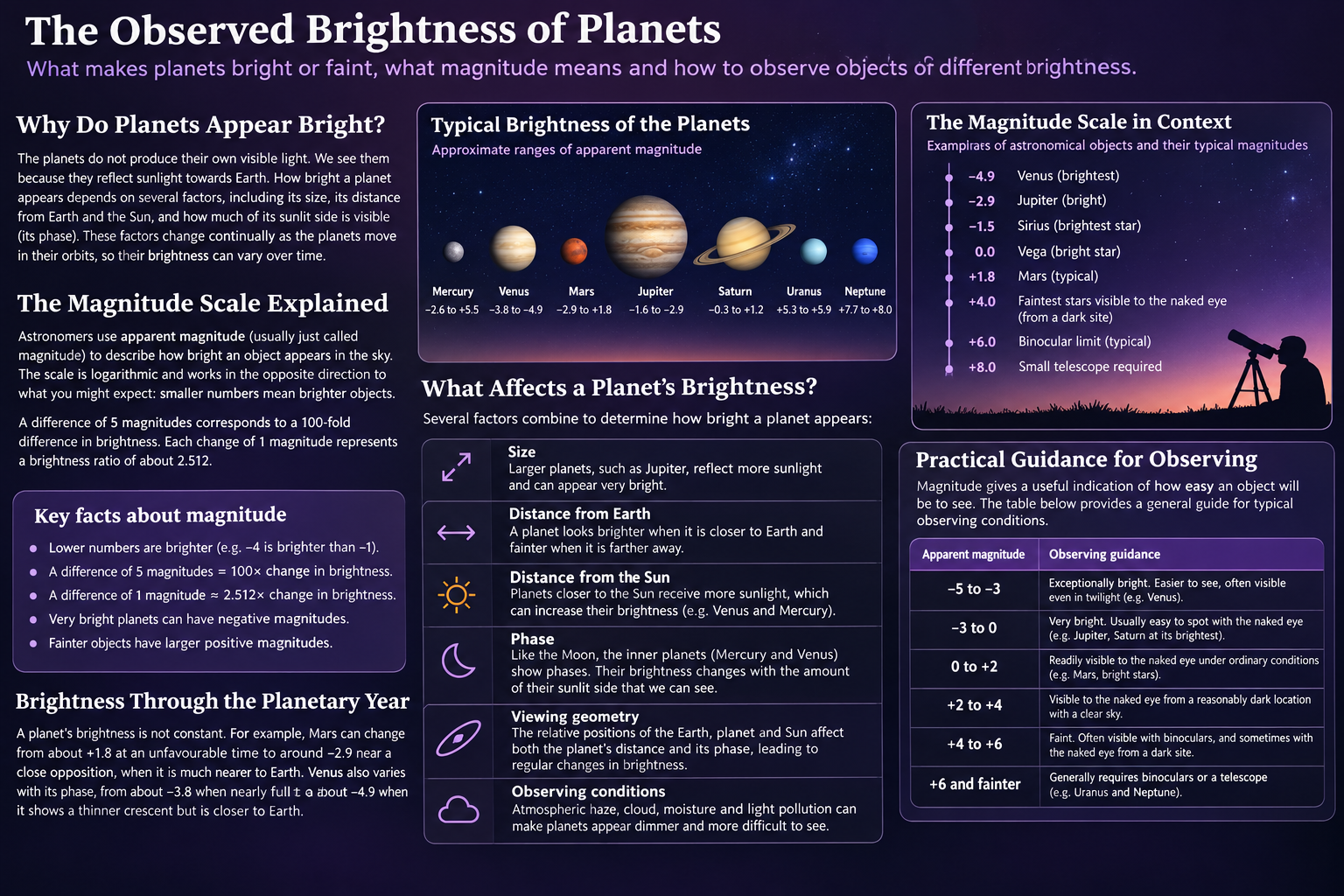
Why Do Planets Shine?
Unlike stars, which generate their own light, planets are visible primarily because they reflect sunlight. Sunlight travels from the Sun to a planet, reflects from its atmosphere or surface, and a small proportion of that reflected light reaches our eyes on Earth.
The brightness we observe depends on several factors. A large planet can reflect more sunlight than a smaller one, while a planet closer to the Sun generally receives more sunlight. Its distance from Earth determines how much of that reflected light reaches us.
The proportion of the planet's illuminated hemisphere facing Earth also matters. This is particularly important for Mercury and Venus, which display phases similar to those of the Moon.
These factors combine to produce the apparent brightness we observe, and they change as the planets travel around the Sun.
Understanding Apparent Magnitude
Astronomers use a measurement called apparent magnitude to describe how bright a celestial object appears from Earth. The scale has an unusual feature: the smaller the magnitude number, the brighter the object.
An object with magnitude 0 is brighter than one with magnitude +2. An object with magnitude -4 is brighter still.
The system has its origins in ancient astronomy, when the Greek astronomer Hipparchus classified visible stars according to their brightness. The brightest stars were placed in the first magnitude category and the faintest in the sixth.
Modern astronomy has refined this classification into a precise mathematical scale that can describe objects much brighter or much fainter than those visible to the naked eye.
A Logarithmic Scale
The magnitude scale is logarithmic rather than linear. A difference of five magnitudes represents a factor of exactly 100 in observed brightness.
A difference of one magnitude corresponds to a brightness ratio of approximately 2.512. Consequently, an object of magnitude +1 is about 2.5 times brighter than an object of magnitude +2.
An object of magnitude -1 is approximately 100 times brighter than an object of magnitude +4. This explains why even relatively small changes in magnitude can represent substantial differences in the amount of light reaching us.
The magnitude scale extends well beyond the planets. The Sun has an apparent magnitude of approximately -26.7, the full Moon is around -12.7, and the brightest star in the night sky, Sirius, is approximately -1.46.
Under exceptionally dark skies, observers with good eyesight may detect stars as faint as magnitude +6 or slightly fainter. Powerful astronomical telescopes can detect objects many magnitudes beyond this limit.
What Affects the Brightness of a Planet?
Distance from the Sun
The amount of sunlight reaching a planet decreases with the square of its distance from the Sun. A planet twice as far from the Sun receives only one quarter as much sunlight per unit area.
This is one reason why the outer planets are generally much fainter than the inner planets. Neptune receives only a small fraction of the sunlight that reaches Earth.
However, distance from the Sun is only one part of the explanation. Jupiter remains very bright despite its great distance because it is enormous and reflects a substantial amount of sunlight.
Distance from Earth
The distance between Earth and a planet changes continuously as both follow their orbits around the Sun.
A planet generally appears brighter when it is closer to Earth because its reflected light is spread over a smaller area by the time it reaches us.
Mars provides a particularly striking example. At favourable oppositions, when Earth passes between Mars and the Sun, Mars can appear exceptionally bright. At other times, when it is much farther away, it becomes a relatively inconspicuous object.
Size and Reflectivity
Larger planets generally have a greater area available to intercept sunlight. However, the proportion of light reflected towards space is also important.
This property is known as albedo. A planet with a high albedo reflects a large proportion of the sunlight it receives, while one with a low albedo absorbs more light.
Venus has a particularly high reflectivity because of its thick cloud cover. These clouds reflect much of the incoming sunlight, contributing to Venus's remarkable brightness.
Mercury, by contrast, has a relatively dark, rocky surface. Despite being closer to the Sun, it is generally much less conspicuous than Venus.
Planetary Phases
Like the Moon, planets can display different illuminated phases when viewed from Earth.
The phases of Mercury and Venus are particularly pronounced because their orbits lie inside Earth's orbit.
When Venus is on the far side of the Sun, we see most of its illuminated hemisphere, but the planet is relatively distant.
As Venus approaches Earth, its apparent diameter increases, but the illuminated portion visible to us becomes smaller.
Venus therefore does not reach its greatest brightness when it appears fully illuminated. Instead, its maximum brightness occurs when it presents a large but partially illuminated disk.
Mars and the more distant planets show much smaller changes in phase when observed from Earth, although their brightness still varies with distance and viewing geometry.
Atmospheric Conditions
The brightness measured by astronomers is not necessarily the brightness perceived by an observer standing beneath Earth's atmosphere.
As light passes through the atmosphere, some is scattered or absorbed. This effect, known as atmospheric extinction, becomes stronger when an object is low above the horizon.
Haze, dust, moisture and thin cloud can further reduce the light reaching an observer.
Light pollution does not necessarily reduce the planet's light directly, but it brightens the surrounding sky, making faint objects more difficult to distinguish.
How Bright Are the Planets?
Each planet has a characteristic range of apparent magnitudes, although its brightness changes as its position relative to Earth and the Sun changes.
Mercury
Mercury's brightness varies considerably with its phase and distance from Earth. It can become surprisingly bright, but its proximity to the Sun makes it challenging to observe. Favourable appearances occur during twilight when the planet stands sufficiently high above the horizon.
Venus
Venus is the brightest planet seen from Earth, reaching an apparent magnitude of approximately -4.9. It is often unmistakable in the evening or morning sky and can sometimes be observed in daylight when its position is known and appropriate precautions are taken.
Mars
Mars undergoes some of the most dramatic brightness changes of any planet. At favourable oppositions it can approach magnitude -3, while at less favourable times it may be around magnitude +2. Its reddish colour helps distinguish it from nearby stars.
Jupiter
Jupiter is usually one of the brightest objects in the night sky, commonly appearing between approximately magnitude -1.6 and -2.9. Its large size and reflective cloud tops make it easy to identify when well placed.
Saturn
Saturn is generally less brilliant than Jupiter, but it remains readily visible to the naked eye under suitable conditions. Its brightness depends partly on the orientation of its rings, which can reflect additional sunlight towards Earth when they are widely tilted.
Uranus
Uranus usually appears near magnitude +5.5 to +6.0. Under exceptionally dark skies it can be detected with the naked eye, but binoculars and a detailed star chart make identification considerably easier.
Neptune
Neptune is much fainter, typically around magnitude +7.7 to +8.0. It is beyond normal naked-eye visibility and requires binoculars or a telescope together with accurate positional information.
Observing Objects of Different Magnitudes
Apparent magnitude provides a useful indication of whether an object might be visible, but it is not a guarantee.
The observing environment, altitude above the horizon, sky brightness, eyesight and optical equipment all influence what can actually be seen.
Very Bright Objects: Magnitude -5 to 0
Objects in this range are usually easy to identify with the naked eye when they are sufficiently separated from the Sun and the sky is reasonably dark.
Venus, Jupiter and Mars at favourable oppositions can fall within this category.
Some very bright planets can be seen during twilight, although their visibility depends strongly on their position in the sky.
Moderately Bright Objects: Magnitude 0 to +3
Objects of these magnitudes are generally straightforward to observe with the naked eye under clear skies.
Saturn and Mars at less favourable distances are often found in this range.
A basic star chart or planet-position guide can help distinguish them from nearby stars.
Fainter Objects: Magnitude +3 to +6
These objects become increasingly difficult to see, particularly from towns and cities.
Under dark rural skies, an experienced observer may detect stars near magnitude +6 with the unaided eye. In brightly illuminated urban areas, the practical limit may be several magnitudes brighter.
Binoculars are useful for locating objects in this range, including Uranus.
Very Faint Objects: Magnitude +6 and Beyond
Objects fainter than magnitude +6 generally require optical assistance for reliable observation.
Neptune, at approximately magnitude +8, can be detected with suitable binoculars under good conditions, although a telescope is often more convenient.
Larger telescopes can reveal much fainter objects, but the limiting magnitude depends on aperture, sky conditions, magnification and observing experience.
Why Magnitude Is Not the Whole Story
Two objects with the same apparent magnitude do not necessarily appear equally easy to observe.
Magnitude describes the total received light, but the way that light is distributed also matters.
A star concentrates its light into an almost point-like image. A planet presents a small disk, although most planets appear star-like to the naked eye.
Large, diffuse objects such as galaxies and nebulae spread their light across a much greater area, making them harder to detect than a star of similar total magnitude.
Sky brightness is equally important. A magnitude +5 star may be easy to identify beneath a dark rural sky but impossible to distinguish against the background glow of a city.
A planet's angular separation from the Sun is another important consideration. Mercury can be intrinsically bright yet difficult to observe because it appears in a bright twilight sky.
Practical Tips for Observing Faint Planets
- Choose a dark location. Move away from direct artificial lighting and, where possible, from major sources of light pollution.
- Allow your eyes to adapt. Spending 20 to 30 minutes in darkness can substantially improve your ability to detect faint objects.
- Observe when the planet is high. A planet at a greater altitude is generally less affected by atmospheric extinction.
- Use binoculars. A modest pair of binoculars can reveal objects much fainter than those visible to the naked eye.
- Use a detailed sky chart. Uranus and Neptune can resemble ordinary faint stars, so accurate positions are essential.
- Observe on several nights. A planet's gradual movement relative to the background stars can help confirm its identity.
- Consider the Moon. Bright moonlight can make faint objects harder to see, so a moonless night is preferable for observing Uranus, Neptune and other faint targets.
Never use binoculars or a telescope to search near the Sun. Accidentally viewing the Sun through an unfiltered optical instrument can cause permanent eye damage.
Using Planet Summary to Compare Brightness
Planet Summary displays the calculated apparent magnitude of each planet alongside its current position, rise and set times, and distance from Earth and the Sun.
Comparing these values over time can reveal how planetary brightness changes as Earth and the planets move around their orbits.
For example, following Mars over several months around opposition can reveal substantial changes in both its distance from Earth and its apparent magnitude.
The brightness values should be treated as estimates of apparent magnitude rather than predictions of actual observing conditions. Local weather, twilight, atmospheric extinction and light pollution are separate factors.
By combining magnitude with altitude, azimuth and rise and set times, you can develop a much clearer picture of which planets are worth observing on a particular night.
Conclusion
The changing brightness of the planets provides a visible demonstration of the movements of our Solar System.
Distance, size, reflectivity and phase all contribute to the amount of light reaching Earth, while atmospheric conditions determine how easily that light can be observed.
Understanding apparent magnitude makes it easier to compare planets, identify promising observing opportunities and appreciate why their appearance changes throughout the year.
The next time you notice a particularly brilliant planet in the evening or morning sky, consider not just how bright it looks, but the remarkable geometry of the Solar System that makes it appear that way.