What is the Ecliptic?
If you spend time observing the night sky, you may notice something curious about the planets. Although they move against the background of stars, they are not scattered randomly across the heavens. Instead, they tend to appear within a relatively narrow band of sky, following broadly the same route as the Sun and Moon.
This apparent alignment is one of the most important features of our Solar System. It is closely related to a reference line astronomers call the ecliptic.
Understanding the ecliptic helps explain why planets appear where they do, why their positions change throughout the year, and why some observing opportunities are much better than others. It also reveals something fundamental about how our Solar System formed.
In this article, we explore what the ecliptic is, why the planets remain close to it, how its position changes in our sky, and how you can use it to find and observe the planets.
What Exactly Is the Ecliptic?
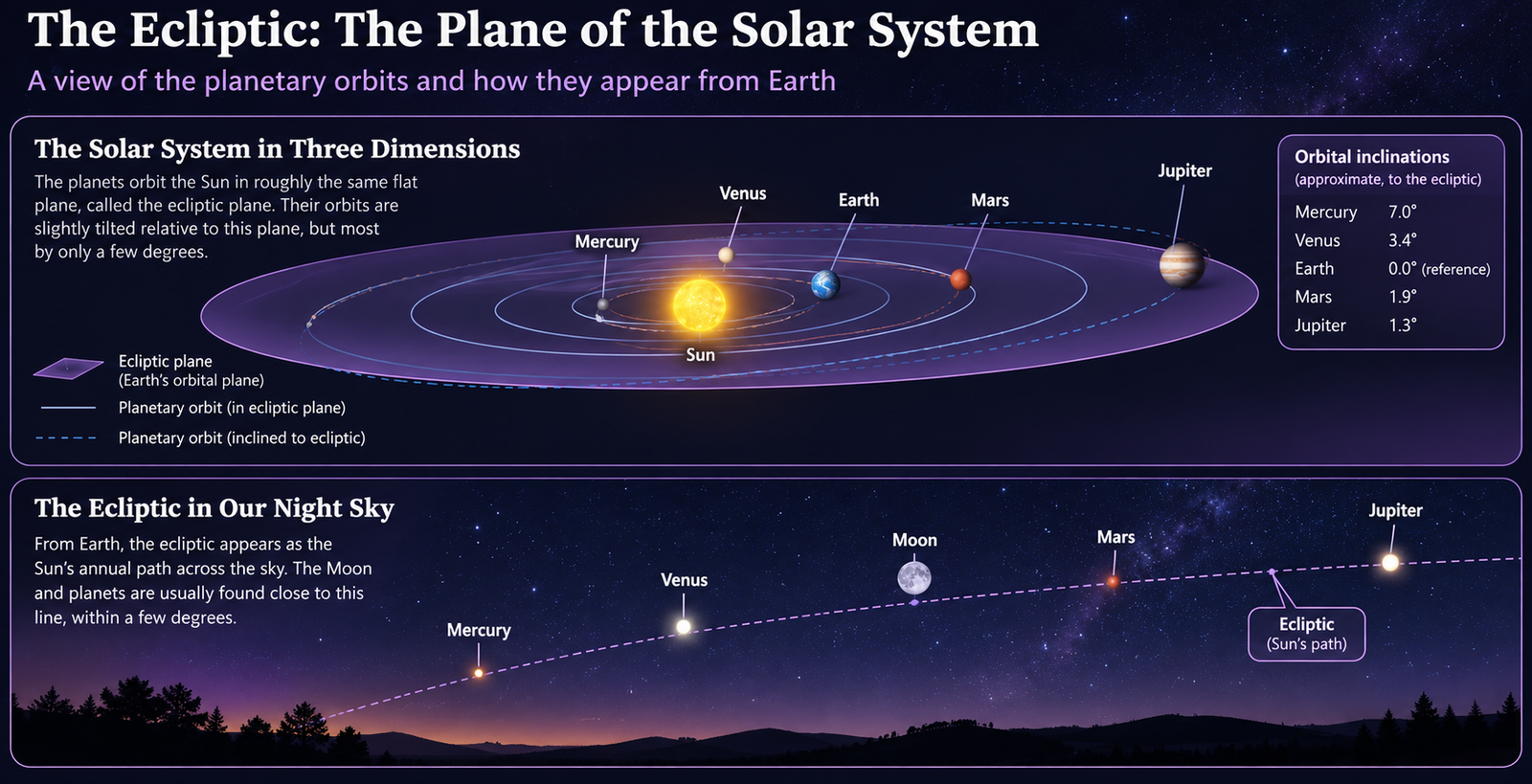
The ecliptic is the apparent path that the Sun follows across the celestial sphere over the course of a year, as seen from Earth.
The celestial sphere is an imaginary sphere surrounding Earth, onto which we can picture the positions of stars, planets and other astronomical objects. Although these objects are actually at very different distances, imagining them projected onto a sphere provides a convenient way to describe their positions in the sky.
As Earth travels around the Sun, the direction in which we see the Sun changes relative to the distant background stars. Over the course of a year, the Sun appears to trace a complete circuit through the constellations.
That annual path is the ecliptic.
The ecliptic can also be understood in a more physical way. Earth's orbit defines a plane in space, known as the ecliptic plane. The ecliptic is where this plane, extended outwards, intersects the imaginary celestial sphere.
This distinction is useful: the ecliptic plane is a flat geometric reference in three-dimensional space, while the ecliptic is the corresponding line we describe in the sky.
Why Does the Sun Appear to Move Along the Ecliptic?
During a single day, the Sun appears to travel from east to west across the sky. This daily movement is caused primarily by Earth's rotation on its axis.
The Sun also changes its position relative to the background stars over the course of the year. This much slower movement is caused by Earth's orbit around the Sun.
Imagine looking towards the Sun from Earth at different points in our orbit. As our viewing position changes, the Sun appears against different regions of the distant stellar background.
After Earth completes one orbit, the Sun has appeared to travel all the way around the ecliptic.
This apparent annual movement is roughly one degree per day, although the exact rate varies slightly because Earth's orbit is elliptical.
We cannot normally see the stars behind the Sun because the daytime sky is too bright, but astronomers can calculate the Sun's position relative to them.
The ecliptic therefore provides a reference path that connects the Sun's changing position with the movement of Earth around it.
Why Do the Planets Follow the Same General Path?
One of the most striking features of the Solar System is that the eight major planets orbit the Sun in approximately the same plane.
Their orbits are not perfectly aligned, but most are inclined by only a few degrees relative to Earth's orbital plane.
Because we observe the other planets from Earth, this arrangement means they generally appear close to the ecliptic in our sky.
The Formation of the Solar System
The explanation begins approximately 4.6 billion years ago, when the Solar System formed from a large cloud of gas and dust.
Gravity caused part of this cloud to contract. As the material collapsed, its rotation became increasingly important.
Conservation of angular momentum caused the rotating material to form a flattened disk around the developing Sun.
This structure is known as a protoplanetary disk. Observations of young stars show that such disks are common during the early stages of planetary system formation.
Within the disk, particles of dust collided and gradually accumulated into larger bodies. Over millions of years, some of these bodies developed into the planets we recognise today.
Because the planets formed within the same flattened disk, they inherited orbits that were broadly aligned.
Most planets also orbit the Sun in the same direction, another consequence of their common origin in rotating material.
Why Aren't the Orbits Perfectly Aligned?
The early Solar System was a dynamic environment. Growing planets interacted gravitationally with one another, and collisions and encounters altered their orbits.
As a result, the planets' orbital planes are slightly inclined relative to one another.
Mercury has the largest inclination among the eight major planets, with its orbit tilted by approximately seven degrees relative to the ecliptic plane.
Venus is inclined by approximately 3.4 degrees, Mars by about 1.9 degrees, and Jupiter by about 1.3 degrees.
These small differences explain why the planets generally appear close to the ecliptic rather than following it exactly.
An orbital inclination is measured relative to the ecliptic plane. The apparent angular separation of a planet from the ecliptic as seen from Earth is not necessarily identical to that inclination.
The Ecliptic and the Zodiac
The ecliptic passes through the familiar region of the sky associated with the constellations of the zodiac.
These constellations form a band around the celestial sphere through which the Sun appears to travel during the year.
The traditional zodiac contains twelve constellations, including Aries, Taurus, Gemini, Cancer and Leo.
However, the astronomical ecliptic also passes through the constellation Ophiuchus, making thirteen modern IAU constellations that the Sun's apparent path crosses.
Because the planets remain close to the ecliptic, they are generally found among the zodiacal constellations or nearby.
This provides a useful practical guide when searching for planets.
If you know where the zodiacal constellations lie, you already know the broad region of sky in which the planets are most likely to appear.
The ecliptic is a scientific reference based on Earth's orbit. Its astronomical meaning is independent of the traditional astrological interpretations of the zodiac.
Does the Moon Follow the Ecliptic?
The Moon also appears close to the ecliptic, although it does not follow exactly the same path.
The Moon's orbit around Earth is inclined by approximately 5.1 degrees relative to the ecliptic plane.
Consequently, the Moon can appear several degrees north or south of the ecliptic as it moves through the sky.
The Moon completes an orbit around Earth in approximately 27.3 days relative to the distant stars, so its position changes noticeably from one night to the next.
The Moon's proximity to the ecliptic is particularly important for understanding eclipses.
Why Is It Called the Ecliptic?
The word ecliptic is closely related to the occurrence of solar and lunar eclipses.
An eclipse can occur when the Sun, Earth and Moon become sufficiently closely aligned.
Because the Moon's orbit is tilted relative to the ecliptic, most new moons and full moons do not produce eclipses.
The Moon usually passes above or below the necessary alignment.
However, twice during each approximately 18.6-year cycle of its orbital nodes, the orientation of the Moon's orbit returns to a similar configuration.
More immediately, eclipse seasons occur roughly six months apart, when the Sun is close to one of the two points where the Moon's orbital plane intersects the ecliptic.
These intersection points are called the lunar nodes.
A solar eclipse can occur when a new moon takes place sufficiently close to a node. A lunar eclipse can occur when a full moon takes place sufficiently close to a node.
The connection between the Sun's apparent path and eclipse geometry gives the ecliptic its name.
The Ecliptic and Earth's Axial Tilt
Earth's rotational axis is tilted by approximately 23.4 degrees relative to the perpendicular to its orbital plane.
This tilt is responsible for the changing seasons and the changing apparent path of the Sun across our sky.
The celestial equator is the projection of Earth's equator onto the celestial sphere.
Because Earth's equator is tilted relative to its orbital plane, the celestial equator and the ecliptic meet at an angle of approximately 23.4 degrees.
They intersect at two points, corresponding to the equinoxes.
The Equinoxes
Around the March and September equinoxes, the Sun crosses the celestial equator.
At these times, the Sun's apparent position lies at one of the two intersections between the celestial equator and the ecliptic.
The Solstices
At the June and December solstices, the Sun reaches its greatest angular separation north or south of the celestial equator.
These positions correspond to the extremes of the Sun's annual movement along the ecliptic.
This relationship between the ecliptic and celestial equator explains why the Sun's daily path changes with the seasons.
How Does the Ecliptic Appear in the Sky?
Although the ecliptic is fixed relative to Earth's orbital plane over short timescales, its apparent orientation in your local sky changes continuously.
Earth's rotation causes the celestial sphere to appear to turn from east to west.
The ecliptic therefore rises, crosses the sky and sets along with the celestial objects near it.
Its angle relative to the horizon depends on your latitude, the time of day and the season.
The Ecliptic in the Northern Hemisphere
At mid-northern latitudes, the ecliptic generally reaches its highest positions towards the southern part of the sky.
During spring evenings, the ecliptic tends to rise relatively steeply from the western horizon.
During autumn evenings, it generally meets the western horizon at a shallower angle.
The opposite seasonal pattern applies to the eastern horizon before sunrise.
The Ecliptic in the Southern Hemisphere
In the Southern Hemisphere, the ecliptic generally reaches its highest positions towards the northern part of the sky.
The seasonal patterns are reversed relative to those experienced in the Northern Hemisphere.
This means that a planet favourably placed for observers in one hemisphere may be much lower in the sky for observers in the other.
Why Does the Ecliptic Matter When Observing Planets?
Understanding the ecliptic can make a substantial difference to how easily you find and observe planets.
Knowing Where to Look
Because the planets appear close to the ecliptic, you can concentrate your search on a relatively narrow region of the sky.
Identifying the Moon or a bright planet can help you estimate the general direction of this band.
The ecliptic itself is not visible, and the planets do not always lie on a perfectly straight line when viewed from the ground.
However, knowing its approximate position provides a useful starting point.
Understanding Planetary Altitude
A planet's altitude above the horizon strongly affects observing quality.
Objects low in the sky are viewed through a greater thickness of Earth's atmosphere.
This can reduce their apparent brightness and make telescopic images less steady.
When the ecliptic passes high across the sky, planets near it can also reach favourable altitudes.
When it remains low, observing conditions may be more challenging.
Observing Mercury and Venus
The orientation of the ecliptic is especially important when observing Mercury and Venus.
These planets orbit closer to the Sun than Earth does, so they never appear very far from the Sun in our sky.
Their maximum angular separation from the Sun is known as greatest elongation.
Even at greatest elongation, a planet may remain low above the horizon if the ecliptic meets the horizon at a shallow angle.
When the ecliptic is steeply inclined to the horizon, the same angular separation can place the planet considerably higher in the twilight sky.
This explains why some appearances of Mercury are much easier to observe than others, even when its separation from the Sun is similar.
Planetary Conjunctions
Because planets remain near the ecliptic, they sometimes appear close together in our sky.
These apparent close approaches are known as conjunctions.
The planets involved may actually be separated by hundreds of millions of kilometres.
Their apparent proximity is simply a consequence of viewing their positions along similar directions from Earth.
Can You See the Ecliptic?
The ecliptic is an imaginary reference line, so it cannot be seen directly.
However, its approximate position can often be inferred from the locations of the Sun, Moon and visible planets.
On a clear evening, try identifying two bright planets or a planet and the Moon.
Their positions will often suggest the general band of sky through which the ecliptic passes.
A planetarium application or astronomical sky chart can display the ecliptic directly, making it easier to recognise its position among the stars.
With practice, you can begin to recognise the ecliptic's changing orientation throughout the seasons.
The Ecliptic and Retrograde Motion
Although the planets generally remain close to the ecliptic, their apparent movement along it is not always in the same direction.
Most of the time, a planet moves gradually eastward relative to the background stars.
However, at certain times, some planets appear to reverse direction temporarily.
This is known as apparent retrograde motion.
For the outer planets, retrograde motion occurs around opposition, when Earth overtakes the planet as both travel around the Sun.
The planet is not actually reversing direction in its orbit. Instead, the apparent reversal results from the changing geometry of our viewpoint.
The planet continues to remain close to the ecliptic throughout this apparent backward movement.
Is the Ecliptic Always in the Same Place?
Over the course of a human lifetime, the ecliptic provides a remarkably stable reference for describing the positions of Solar System objects.
However, Earth's rotational axis slowly changes direction through a process known as axial precession.
This causes the positions of the equinoxes to shift gradually along the ecliptic, completing a cycle in approximately 26,000 years.
The orientation of Earth's orbital plane also changes slowly because of gravitational interactions with other planets.
These changes are extremely gradual and do not affect ordinary observing plans, but they are important for precise astronomical calculations over long periods.
Using Planet Summary to Explore the Ecliptic
Planet Summary provides current positions, rise and set times, and observing information for the major planets.
By comparing the positions of several planets, you can begin to appreciate how they occupy the same general region of the sky.
The altitude and azimuth values help you locate individual planets from your selected location.
Rise and set times indicate when the planets will be above your local horizon, while their changing positions illustrate the combined effects of Earth's rotation and planetary motion.
Following the planets over several weeks or months is a particularly rewarding way to understand the ecliptic in practice.
What initially appears to be a collection of unrelated bright objects becomes a visible demonstration of the orderly structure and motion of our Solar System.
Conclusion
The ecliptic is one of the most useful reference lines in astronomy.
It describes the Sun's apparent annual path through the sky and represents the projection of Earth's orbital plane onto the celestial sphere.
The planets remain close to this path because they formed within a common rotating disk of material around the young Sun.
For observers, understanding the ecliptic provides a practical guide to locating planets, interpreting their movements and recognising favourable observing conditions.
The next time you see several planets spread across the night sky, imagine the great plane of the Solar System extending outward through space.
The apparent alignment of those distant worlds is a direct reflection of the structure of the planetary system in which we live.