Space-based Distance Measurements
Space is extraordinarily large. Even the distances between neighbouring planets are difficult to comprehend using the measurements we encounter in everyday life. Beyond our Solar System, the distances between stars and galaxies become so enormous that familiar units such as kilometres are no longer particularly convenient.
Astronomers therefore use several different units to describe distances in space. Kilometres are useful when discussing satellites and nearby celestial bodies. Astronomical units provide a convenient scale for measuring distances within the Solar System, while light-seconds, light-minutes, light-hours and light-years help us understand the vast distances travelled by light.
These measurements are not simply different ways of expressing large numbers. Each provides a useful perspective on the scale of the Universe and the practical challenges of observing and exploring it.
In this article, we explore the most commonly used astronomical distance measurements, explain how they relate to one another, and use familiar objects throughout the Solar System and beyond to illustrate the remarkable scale of space.
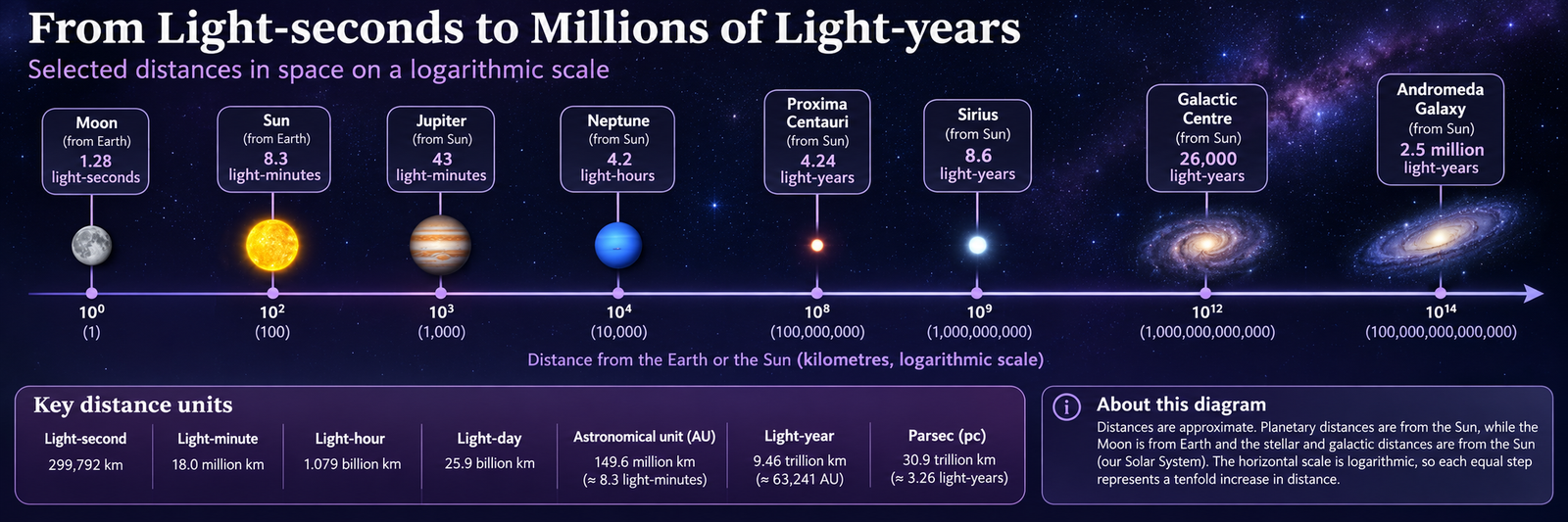
Why Do We Need Different Units of Distance?
On Earth, kilometres are suitable for describing most journeys. A drive between two cities might cover a few hundred kilometres, while the circumference of Earth is approximately 40,000 kilometres.
In space, even relatively nearby objects are separated by much greater distances. The Moon is approximately 384,400 kilometres from Earth on average, while the Sun is about 150 million kilometres away.
Neptune, the most distant major planet from the Sun, orbits at an average distance of approximately 4.5 billion kilometres. The nearest star beyond the Sun is more than 40 trillion kilometres away.
All these distances can be expressed in kilometres, but the resulting numbers quickly become difficult to read, compare and remember.
Astronomers solve this problem by selecting units appropriate to the scale being discussed. Just as we might measure the thickness of a sheet of paper in millimetres and a journey across a country in kilometres, astronomical measurements use different units for different situations.
Kilometres: Measuring Nearby Space
The kilometre is a familiar unit and remains extremely useful in astronomy and space exploration. It is particularly appropriate for measuring the sizes of planets, the altitudes of satellites, and distances between nearby objects.
Satellites and Earth Orbit
The International Space Station normally orbits approximately 400 kilometres above Earth's surface. This is a surprisingly small distance compared with the size of our planet, whose equatorial diameter is approximately 12,756 kilometres.
Geostationary satellites operate much farther away, at an altitude of approximately 35,786 kilometres above the equator. At this altitude, a satellite's orbital period matches Earth's rotation, allowing it to remain above approximately the same location on the surface.
These distances are sufficiently small that kilometres provide a clear and convenient measurement.
The Distance to the Moon
The Moon orbits Earth at an average centre-to-centre distance of approximately 384,400 kilometres.
Its orbit is not perfectly circular, so the distance changes throughout the lunar month. The Moon is closer to Earth at perigee and farther away at apogee.
As a rough illustration, if a spacecraft could travel directly towards the Moon at a constant speed of 100 kilometres per hour, the journey would take about 160 days.
Actual spacecraft travel along orbital trajectories and at very different speeds. The Apollo missions typically took around three days to reach the vicinity of the Moon.
When Kilometres Become Inconvenient
Although kilometres work well for nearby space, they become cumbersome when describing distances between planets.
The average distance from the Sun to Jupiter is approximately 778 million kilometres. For Neptune, the corresponding distance is approximately 4.5 billion kilometres.
These numbers are perfectly valid, but a different unit makes comparisons much easier.
The Astronomical Unit (AU)
The astronomical unit, abbreviated to AU, is one of the most useful measurements for describing distances within the Solar System.
One astronomical unit is defined as exactly 149,597,870.7 kilometres. This is approximately the average distance between Earth and the Sun.
The AU provides a convenient reference point. Instead of saying that Jupiter is approximately 778 million kilometres from the Sun, we can describe its average orbital distance as approximately 5.2 AU.
Similarly, Neptune's average orbital distance is approximately 30 AU.
Distances of the Planets from the Sun
The following table shows the approximate average orbital distances of the eight major planets, expressed in astronomical units and millions of kilometres.
| Planet | Distance (AU) | Distance (million km) |
|---|---|---|
| Mercury | 0.39 | 57.9 |
| Venus | 0.72 | 108.2 |
| Earth | 1.00 | 149.6 |
| Mars | 1.52 | 227.9 |
| Jupiter | 5.20 | 778.6 |
| Saturn | 9.58 | 1,433.5 |
| Uranus | 19.2 | 2,872.5 |
| Neptune | 30.1 | 4,495.1 |
These are approximate average distances from the Sun, based on the planets' orbital sizes. They should not be confused with the planets' current distances from Earth.
Why Planetary Distances Change
Planets follow elliptical rather than perfectly circular orbits. Their distances from the Sun therefore vary as they travel around their orbits.
The distance between Earth and another planet changes even more dramatically because both planets are moving.
Mars provides a useful example. At a particularly favourable close approach, Mars can come within approximately 55 million kilometres of Earth, or about 0.37 AU.
When Earth and Mars are on approximately opposite sides of the Sun, their separation can exceed 400 million kilometres, or around 2.7 AU.
This is why Planet Summary displays both the distance of each planet from the Sun and its current distance from Earth. The two measurements describe different aspects of the planet's position in the Solar System.
Beyond the Planets
Astronomical units are also useful for describing the distances of comets, asteroids and spacecraft travelling through the outer Solar System.
Pluto, which is classified as a dwarf planet, has an average orbital distance of approximately 39.5 AU from the Sun.
The Kuiper Belt, a region containing many icy bodies beyond Neptune, extends across a broad range of distances, with its principal population occupying roughly 30 to 50 AU from the Sun.
Farther away, the hypothetical Oort Cloud is thought to contain icy bodies at distances extending thousands or even tens of thousands of astronomical units from the Sun.
At these distances, even the astronomical unit begins to become less convenient.
Measuring Distance Using Light
One of the most useful ways to understand astronomical distances is to consider how long light takes to travel between objects.
Light travels through a vacuum at exactly 299,792,458 metres per second, or approximately 300,000 kilometres per second.
This is the fastest speed at which information can travel through space, according to our current understanding of physics.
Despite this extraordinary speed, the distances in space are so great that light takes measurable amounts of time to travel between objects.
Astronomers therefore often express distance as the amount of time light would take to travel that distance through a vacuum.
These are measurements of distance, not time, even though their names include familiar time units.
Light-seconds
A light-second is the distance light travels through a vacuum in one second.
This is approximately 299,792 kilometres.
Light-seconds are useful when discussing relatively short astronomical distances, particularly within the Earth-Moon system.
Earth to the Moon
Light takes approximately 1.28 seconds to travel from the Moon to Earth at the Moon's average distance.
This means that when we look at the Moon, we see it as it was about 1.3 seconds ago.
The same delay affects radio communications with spacecraft on the lunar surface. A radio signal takes approximately 1.3 seconds to travel one way, and about 2.6 seconds for a round trip, ignoring additional processing delays.
During the Apollo missions, this delay was noticeable in conversations between astronauts on the Moon and mission controllers on Earth.
Other Uses of Light-seconds
Light-seconds are also useful for describing distances to nearby spacecraft and the changing separation between objects in the inner Solar System.
They provide an intuitive connection between physical distance and the communication delays encountered during space exploration.
Light-minutes
A light-minute is the distance light travels in one minute, approximately 18 million kilometres.
Light-minutes are particularly useful for describing distances between the Sun, Earth and the inner planets.
Sunlight Takes Time to Reach Earth
Light from the Sun takes approximately 8 minutes and 19 seconds to reach Earth when the two are separated by one astronomical unit.
This means that we never see the Sun exactly as it is at the present instant. We see the sunlight that left its surface a little over eight minutes earlier.
The same principle applies to every astronomical object we observe. Looking into space always means looking into the past.
Communication with Mars
The distance between Earth and Mars varies considerably, so the time taken for radio signals to travel between them also changes.
Depending on the positions of the planets, a radio signal may take approximately 3 to 22 minutes to travel one way.
This makes direct, real-time control of a Mars rover impractical.
Instead, mission controllers send commands, and the rover carries out many operations autonomously before returning information to Earth.
The communication delay is one of the important differences between operating spacecraft near Earth and exploring more distant planets.
Light-hours
A light-hour is the distance travelled by light in one hour, approximately 1.079 billion kilometres.
Light-hours are useful for describing distances across the outer Solar System.
Jupiter and Saturn
Jupiter orbits the Sun at an average distance of approximately 5.2 AU. Sunlight therefore takes roughly 43 minutes to reach Jupiter.
Saturn is farther away, at approximately 9.6 AU. Sunlight takes about 1 hour and 20 minutes to reach it.
Uranus and Neptune
Uranus is approximately 19.2 AU from the Sun on average, corresponding to a sunlight travel time of about 2 hours and 40 minutes.
Neptune, at approximately 30 AU, receives sunlight that has been travelling for about 4 hours and 10 minutes.
These are approximate sunlight travel times based on average orbital distances. The travel time from Earth to each planet changes as the planets move.
Voyager and the Outer Solar System
NASA's Voyager spacecraft have travelled far beyond the orbits of the major planets.
Voyager 1 has crossed the heliopause, the boundary beyond which the solar wind no longer dominates the surrounding interstellar plasma.
At distances of more than 150 AU from the Sun, radio signals take more than 20 hours to travel between the spacecraft and Earth.
This means that even a simple command and response can require nearly two days, demonstrating the extraordinary challenges of communicating across the outer Solar System.
Light-days
A light-day is the distance light travels in 24 hours, approximately 25.9 billion kilometres.
Although less commonly used than light-years or astronomical units, light-days can provide a useful perspective on the outermost regions of the Solar System.
One light-day is equivalent to approximately 173 AU.
For comparison, Neptune orbits at only about 30 AU, so light travels from the Sun to Neptune in a small fraction of a day.
The enormous distances associated with the hypothetical Oort Cloud can be expressed in light-days or light-months, although astronomers often prefer AU or light-years.
Light-years: Measuring the Distances Between Stars
Beyond the Solar System, even astronomical units become inconveniently small.
Astronomers therefore frequently use the light-year.
A light-year is the distance light travels through a vacuum in one Julian year, defined as 365.25 days.
One light-year is approximately 9.46 trillion kilometres, or about 63,241 AU.
Despite its name, a light-year is a measurement of distance, not a measurement of time.
The Nearest Star Beyond the Sun
Proxima Centauri, part of the Alpha Centauri star system, is the nearest known star to the Sun.
It lies approximately 4.24 light-years away.
This means that light reaching Earth from Proxima Centauri has been travelling for about 4.24 years.
Even travelling at the speed of light, a journey to Proxima Centauri would take more than four years as measured in the reference frame of Earth.
Spacecraft travel far more slowly, so a journey to another star using present-day propulsion technology would take vastly longer.
Sirius and Other Nearby Stars
Sirius, the brightest star in Earth's night sky, is approximately 8.6 light-years away.
Vega, a prominent star in the constellation Lyra, is approximately 25 light-years away.
Betelgeuse, the reddish supergiant in Orion, is hundreds of light-years away, although its precise distance remains uncertain.
When we observe these stars, we see light that began its journey years, decades or centuries ago.
Distances Across the Milky Way
Our Solar System is part of the Milky Way galaxy, an enormous collection of stars, gas, dust and dark matter.
The Milky Way's stellar disk is approximately 100,000 light-years across, although its exact extent depends on how its boundaries are defined.
Our Solar System lies approximately 26,000 light-years from the Galactic Centre.
This means that the light we receive today from the region around the centre of our galaxy began its journey roughly 26,000 years ago.
These distances illustrate how even our own galaxy is extraordinarily large compared with the Solar System.
Distances to Other Galaxies
The light-year remains useful when discussing galaxies beyond the Milky Way, although the distances are often expressed in millions or billions of light-years.
The Andromeda Galaxy
The Andromeda Galaxy, also known as M31, is the nearest large spiral galaxy to the Milky Way.
It lies approximately 2.5 million light-years from Earth.
When we observe Andromeda, we see light that left the galaxy approximately 2.5 million years ago.
At that time, early human ancestors were living on Earth, long before the emergence of modern human civilisation.
Looking Billions of Years into the Past
Powerful telescopes can detect galaxies whose light has travelled for billions of years before reaching us.
Observing such distant objects allows astronomers to investigate the Universe at much earlier stages of its history.
At these enormous distances, however, the expansion of the Universe becomes important.
A galaxy whose light has travelled for 10 billion years is not necessarily 10 billion light-years away today.
Space has expanded while the light was travelling, so the galaxy's present-day distance can be substantially greater.
Astronomers distinguish between light-travel time and several different cosmological distance measurements when studying the distant Universe.
Parsecs: Another Astronomical Distance Unit
Professional astronomers frequently use another unit called the parsec, abbreviated to pc.
One parsec is approximately 3.26 light-years, or 206,265 AU.
The parsec is based on a geometric method of measuring stellar distances known as parallax.
As Earth travels around the Sun, nearby stars appear to shift slightly relative to more distant background stars.
A star at a distance of one parsec has an annual parallax angle of one arcsecond, where the angle is measured using the Earth-Sun distance as the baseline.
This provides a direct geometric way to calculate the distances of nearby stars.
Astronomers use kiloparsecs, representing thousands of parsecs, for distances within galaxies, and megaparsecs, representing millions of parsecs, for distances between galaxies.
Although light-years are often more intuitive for general audiences, parsecs are especially useful in professional astronomy because of their connection to measurement techniques.
How Do Astronomers Measure These Distances?
Knowing the units is only part of the story. Astronomers must also determine how far away celestial objects actually are.
Radar and Radio Ranging
Within the Solar System, distances can be measured using radar or radio signals.
A signal is transmitted towards a suitable target, and the time taken for its return is measured.
Because the speed of light is known, the distance can be calculated from the signal's travel time.
Radio tracking of spacecraft also provides extremely precise information about their positions and trajectories.
Stellar Parallax
For nearby stars, astronomers use parallax to measure their apparent displacement as Earth moves around the Sun.
ESA's Gaia mission has measured the positions and parallaxes of enormous numbers of stars, greatly improving our knowledge of the structure of the Milky Way.
Standard Candles
At greater distances, parallax becomes too small to measure accurately.
Astronomers then use objects whose intrinsic brightness can be estimated, such as certain variable stars and Type Ia supernovae.
By comparing their intrinsic brightness with their observed brightness, astronomers can estimate their distances.
Redshift and Cosmic Expansion
For distant galaxies, astronomers can study the redshift of their light.
As the Universe expands, the wavelengths of light travelling through space are stretched.
By measuring this redshift and applying a cosmological model, astronomers can estimate distances on the largest scales.
Comparing Astronomical Distance Units
The following table summarises the approximate distances represented by the most commonly used astronomical units.
| Unit | Approximate distance | Example |
|---|---|---|
| Kilometre | 1 km | Satellite altitudes |
| Light-second | 299,792 km | Moon: about 1.3 light-seconds |
| Light-minute | 18 million km | Sun: about 8.3 light-minutes |
| Astronomical unit | 149.6 million km | Earth-Sun reference distance |
| Light-hour | 1.079 billion km | Saturn: about 1.3 light-hours from Sun |
| Light-day | 25.9 billion km | Outer Solar System distances |
| Light-year | 9.46 trillion km | Proxima Centauri: 4.24 light-years |
| Parsec | 30.9 trillion km | Nearby stellar distances |
A Journey Through the Scales of Space
To appreciate how dramatically astronomical distances increase, imagine travelling outward from Earth.
After travelling approximately 400 kilometres, you would reach the orbital altitude of the International Space Station.
At around 384,400 kilometres, you would reach the Moon's average orbital distance. Light covers this distance in just over one second.
At approximately 150 million kilometres, you would reach Earth's average distance from the Sun: one astronomical unit, or about 8.3 light-minutes.
Neptune lies roughly 30 times farther from the Sun than Earth does, requiring sunlight to travel for more than four hours.
Beyond the planetary system, the distances become much greater still.
The nearest star beyond the Sun is over four light-years away. Our galaxy spans approximately 100,000 light-years, and the Andromeda Galaxy lies around 2.5 million light-years from Earth.
The observable Universe extends to a present-day radial distance of approximately 46 billion light-years, even though the Universe is approximately 13.8 billion years old.
This is possible because space itself has expanded during the time that light has been travelling.
These comparisons demonstrate why no single unit is convenient for describing every astronomical distance.
Frequently Asked Questions
Is a light-year a measurement of time?
No. A light-year measures distance: the distance light travels through a vacuum in one Julian year.
How many kilometres are in one AU?
One astronomical unit is defined as exactly 149,597,870.7 kilometres.
How long does sunlight take to reach Earth?
At a distance of one AU, sunlight takes approximately 8 minutes and 19 seconds to reach Earth. The actual travel time varies slightly throughout the year.
How far away is the Moon in light-seconds?
At its average distance, the Moon is about 1.28 light-seconds from Earth.
Why do astronomers use parsecs?
The parsec is directly related to the geometric measurement of stellar parallax. This makes it particularly useful in professional astronomy.
Does looking into space mean looking into the past?
Yes. Because light takes time to travel, we observe distant objects as they were when the light left them. The farther away an object is, the farther back in time we generally see.
Understanding Distances with Planet Summary
Planet Summary displays the calculated distances of the planets from Earth and from the Sun, expressed in astronomical units.
These distances change continuously as the planets follow their orbits around the Sun.
By comparing their current distances with their apparent brightness, rise and set times, and positions in the sky, you can develop a clearer understanding of the changing geometry of our Solar System.
Astronomical units make the scale of planetary distances easier to appreciate, while light-travel times remind us that even our nearest celestial neighbours are separated by immense distances.
From the Moon, just over a light-second away, to galaxies millions of light-years distant, astronomical measurements provide a way to understand the extraordinary size and structure of the Universe.